The Telegraph India

Italy’s “mystery” writer is coming to India

While we are on the subject of writing in Italian, Jhumpa’s translator Ann Goldstein has done the English-reading world a far bigger favour by translating the beautiful, beautiful books of Elena Ferrante. No one quite knows who this writer is, because Elena Ferrante is a pen name and despite writing hugely successful novels in Italian since 1992 and having sold thousands or copies in English translations, she remains anenigma. Here’s what she reportedly wrote to her publishers: “I believe that books, once they are written, have no need of their authors. If they bave something to say, they will sooner or later find readers; if not, they won’t.. .. Besides, isn’t il true that promotion is expensive? I will be the least-expensive author of the publishing house. I’ll spare you even my presence.” \Veli, there isn’t even confirmation whether this is a woman, though readers and critics insist that her voice is distinctly feminine, and a journalist with The New Yorker has revealed that in her written correspondence, the writer has referred to herself as a “mother”. But then even male writers are known to say they are “pregnant with my next book”. So there. Some or the most famous Ferrante books, apart from Days of Abandonment, are the four Neapolitan novels -My Brilliant Friend, Story of a New Name, Those Who Leave and Those Who Stay and Story of a Lost Child- that follow the lives of two friends, Lenu and Lila, from their girlhood in post-war Italy to adulthood. Ferrante writes with a keen eye and a sharp pen, never papering over the cruelty that children are capable of inflicting on one another or the frequent death of dreams that mark ordinary lives. And her insights into human nature and pithy observations on life can cu t through you like invisible laser, keeping you awake into the night far more than a whodunit ever could. No wonder her fandom is said to have “Ferrante Fever”! Till now readers in India had to either buy expensive international editions of Ferrante’s English titles or read e-books but come March, Europa Editions will bring out Indian edìtions of the Neapolitan novels, to be distributed by Penguin Random House. Here’s wisbing you catch Ferrante Fever too!

Amy’s Smart Girls

BIBLIOPHILES REVIEW: MY BRILLIANT FRIEND

Bibliophiles Review: My Brilliant Friend

Alright, it’s time for another Bibliophiles Review with Trilby and Charlotte! This week we’re discussing My Brilliant Friend, a modern masterpiece by one of Italy’s most acclaimed authors: Elena Ferrante. The story begins in the 1950’s in a poverty-striken neighborhood in Naples and is narrated by Elena, an impressionable woman who recalls her Neapolitan childhood with keen attention to detail. Her “brilliant friend” was Lila, the daughter of a shoemaker. Lila served as Elena’s polar opposite, a street-smart, naturally gifted “go-getter.” As the novel moves along, the two friends are offered different opportunities for adulthood, though their friendship remains an unforgettable source of inspiration. The book is driven by its fascinating characters, who continuously make surprising choices.

Continue reading →

The Irish Times

Ebook reviews: Discovering new worlds with #womenintranslation

My various digital devices, meanwhile, made reading Elena Ferrante’s much-lauded Naples Quadrilogy (Kindle Edition, £4.80 each) much easier. If I hadn’t also insisted on buying the paperback editions, for €18 each, it would have also saved me a fortune.

The books chart the relationship between two childhood friends over 40 years. As the narrator, Elena Greco, abandons her working-class roots for an intellectual life, Ferrante artfully charts the changes in post-war Italian society: the class struggle, the continued vice grip of Fascism, and the role of women within a notoriously patriarchal culture.

An enormous cast of characters appear and reappear over more than 1,200 pages, and Ferrante cleverly provides a cast list, grouped by family, at the start of each book. I found the character-map much easier to access in paperback than in ebook form, where the scrolling distracted me from the thrust of the story.

The books – particularly the first two parts, My Brilliant Friend and The Story of the Lost Child – are as addictive as a soap-opera, and Ferrante ends both with the sort of cliff-hanger that can only be satisfied by an instant progression to the next book. Here, the digital versions won out, allowing me to jump from one instalment to the next without getting up from the couch.

Writerly States

Katherine Hill on Saving Books, Literary Power, & Ferrante Fever (Part 4)

Katherine Hill is the author of The Violet Hour, a novel published by Scribner in 2013. Her fiction, essays, and reviews have appeared in n+1, The Guardian, and Bookforum, among other publications, and she has taught writing in the MFA Program at Arcadia University as well as prison programs via Princeton and PEN New England. She now serves on the PEN Prison Writing Program Committee and is a regular book critic for the Philadelphia Inquirer. A graduate of Yale and the Bennington Writing Seminars, she lives in New York City.

Ursula K. Le Guin’s Blog

108. Some Books I Read in 2015

Elena Ferrante’s Naples Quartet.

Ferrante-BrilliantFriendI’ve read only the first two books. Found the first absorbing, fascinating, and a terrific study of urban class and gender structure – the social anthropology novel at its best. The second somewhat more predictable but still satisfying, especially the last half. But at the very end of it, the Worthless Prick suddenly pops up again. Oh, no! Is all the interest, all the promise of the protagonists – of the novel itself – to be thrown away on the women-adoring-a-jerk story, the love-as-addiction story? Again? I’ve gone on that nowhere trip with a novel way too often. I’m not signing on for this one. Maybe I’ll come back to the third and fourth volumes after a while. Maybe not.

Meanwhile I keep wondering why the mysteriously elusive Elena Ferrante is so mysteriously elusive. Because being mysteriously elusive is great PR, well, sure. But there’s another possibility. The psychological study of two minds, a relationship between two girls growing into women, while brilliant, is entirely in terms originated by and therefore acceptable to men (the central focus of a woman’s life is a man; women can’t and don’t trust other women). The intense competitiveness of the two girls is perfectly plausible, but as the main element of a friendship between women it ceased to convince me; mere rivalry seldom plays the part in women’s lives that it does in many men’s. And then, Lina is such a classic male-dream-woman, the eternal Carmen, magnetically sexy, fiery, holding herself apart from other women but eagerly abasing herself to the male animal…. Women of course write about such women, and often, but seldom at this level of sophistication.

Anyhow, for what it‘s worth, I’m laying no bets on the gender of the coy author.

The New Yorker

The Ideal Marriage, According to Novels

BY

He said things that I could never have thought, or at least said, with the same assurance, and he said them in a strong engaging Italian.” So thinks Elena Greco, the heroine of Elena Ferrante’s Neapolitan novels, about Nino, the young man she is just then beginning to fall in love with, in “My Brilliant Friend,” the first book in the series. Nino doesn’t have her best friend Lila’s “capacity to make everything fascinating,” Elena observes coolly, but he is well informed, and when he discusses issues like poverty, he sounds less like a teen-ager than a man, speaking “not generically, in sorrowful accents . . . but concretely, impersonally, citing precise facts.” He also writes for magazines, which impresses Elena, who is herself an aspiring writer.

The four Neapolitan novels cover a period of sixty-odd years, and one of the strengths of the relationship that Elena goes on to have with Nino is the encouragement he gives to her own work. When, as a mother of two young children in her early thirties, she has largely abandoned her writing, he successfully urges her to take it up again. Nino praises her generously: “What I envy most is your ability as a narrator,” he tells her. Because Elena believes in Nino, in his judgment, his admiration has weight.

Continue reading →

Bustle

12 Books With Awesome Sequels

Here’s a question for you: what do pumpkin spiced lattes, puppies, chocolate cupcakes, and books all have in common? Give up? OK, I’ll tell you. When it comes to PSLs, furry pups, cupcakes (of pretty much any flavor,) and books, more is ALWAYS better. Ergo, books with awesome sequels — the ones that invite you to spend even more time with your favorite characters, take you back to that setting you love, and answer all those questions that left you hanging in the first book — are, well, awesome.

Continue reading →

Metro Politics

Parallel Lives? Elena Ferrante’s Naples and My West New Rochelle

by Bella Mirabella, le 26/01/2016

Elena Ferrante’s acclaimed Neapolitan novels, which trace the lives of two girls born in a working class district in Naples, Italy in 1944, can be read as a meditation on the role of the neighborhood in shaping class, gender and ethnic identity. In this essay, Italian-American scholar Bella Mirabella reflects on her own community of origin, West New Rochelle, New York, in light of the resonances she encountered reading Ferrante’s books.

Elena Ferrante’s four Neapolitan novels (My Brilliant Friend,The Story of a New Name, Those Who Leave and Those Who Stay, and The Story of the Lost Child) [1] are a vast survey of life in Naples and Italy after World War Two. Telling the stories of the narrator Lenù and her friend Lila, born in August of 1944, the books encompass friendship, family, neighborhood, the Mob, gender and class politics, the burdens of poverty, the challenges of changing class position through education, and the radical movements of the 1970s. Having grown up in an Italian-American neighborhood in the suburban city of New Rochelle, outside of New York City, at about the same time, I was struck by many parallels: Southern Italian pastries on Sunday, a huge cast of familial and neighborhood characters, the presence of the Mob, hostility to education, complicated and fraught relationships between men and women, the male quest for a masculinity that will guarantee honor and respect, the power and all-seeing eyes of the family and the neighborhood, and the pervasive feeling of inferiority that results from the triadic pressures of class, ethnicity, and gender. Such pressures do not disappear; their presence exerts a structuring influence on lives even away from the neighborhood, and through a lifetime.

Continue reading →

Rosemary and Reading Glasses

Recommended Reading: My Brilliant Friend, by Elena Ferrante, Translated by Ann Goldstein

Yes, it’s just as good as everyone’s been saying—and I’m very glad I waited to read it.

IMG_5767

No doubt you’ve heard of the Neapolitan novels, the quartet of books by Italian writer Elena Ferrante (whose identity is not known; she’s used a pen name since her first novel was published more than twenty years ago) and translated by Ann Goldstein.

I do wish someone would give Ann Goldstein a medal, because the translation is superb, as far as this non-Italian speaker can tell—it flows exactly as it should; one never stops to think of it as a translation.

My Brilliant Friend tells of the childhood and adolescence of Elena (or Lenu), the narrator, and Lila, her enigmatic, incredibly, almost dangerously intelligent friend. Both girls are sensitive, inquisitive, brave, desirous of accomplishment; but Lila has “the characteristic of absolute determination,” while Elena sometimes flounders, unsure of herself, looking to Lila as an anchor. Their subtle competition with each other wends through the novel, as Elena reaches back into her memory to understand her friend and rival. This is best bildungsroman I’ve read since Jane Eyre, though of course completely different in scope and setting. Lila and Elena, both born in 1944, live in a rough neighborhood on the fringes of Naples; parents hitting children and husbands hitting wives are commonplace. In their neighborhood wealth stands out, as do book smarts, though neither is particularly welcome; Elena recalls, “we grew up with the duty to make it difficult for others before they made it difficult for us.”

The structure of the novel reminded me of a sidewinder; it moves forward, but often by moving sideways. Elena sets a scene—a confrontation with rock-throwing boys after school (considerably less tame than a similar scene in Anne of Green Gables, by the way)—only to skip away laterally and return to it later. Ms. Ferrante is so talented, though, that these parries and feints aren’t jarring, but fluid.

I put off reading these books for two reasons, one good and one bad. The bad reason is that I find the covers off-putting, though thematically appropriate. The good reason, or the reasonable reason, perhaps, is that each installment of the series appeared a year apart, the last in September 2015; I suspected, based on the praise I heard, that I would not want to wait before delving into each subsequent novel. That suspicion was correct; within a half hour of finishing My Brilliant Friend, I was twenty pages into The Story of a New Name. I can’t wait to see what happens, how Lila and Elena will illuminate each other’s lives.

The New York Times

What to Do in Elena Ferrante’s Naples

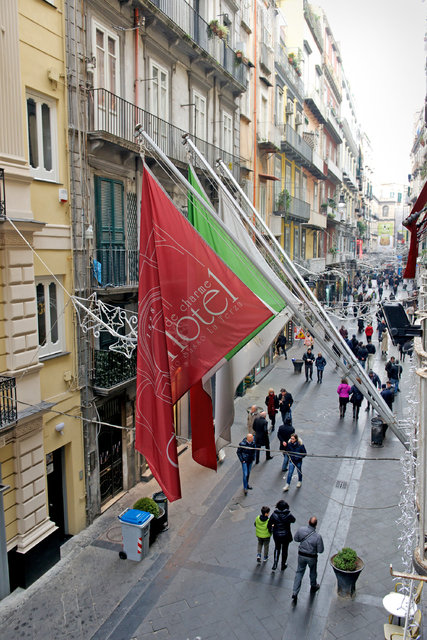
Last week, we published an article about using the Neapolitan novels of Elena Ferrante as guidebooks toNaples. “As I discovered during a visit in September,” Ann Mah wrote, “the series of books offered a unique view of this complicated city, leading me away from popular tourist sites and helping to explain the city’s social, economic and geographic divisions. To view the Naples of Ms. Ferrante is to view Naples like a native.”

Here are some tips on how to navigate Ms. Ferrante’s Naples. (A note for those who haven’t read the novels, including the latest, “The Story of the Lost Child”: spoilers ahead.)

Continue reading →

The New Yorker

The Ideal Marriage, According to Novels

BY

He said things that I could never have thought, or at least said, with the same assurance, and he said them in a strong engaging Italian.” So thinks Elena Greco, the heroine of Elena Ferrante’s Neapolitan novels, about Nino, the young man she is just then beginning to fall in love with, in “My Brilliant Friend,” the first book in the series. Nino doesn’t have her best friend Lila’s “capacity to make everything fascinating,” Elena observes coolly, but he is well informed, and when he discusses issues like poverty, he sounds less like a teen-ager than a man, speaking “not generically, in sorrowful accents . . . but concretely, impersonally, citing precise facts.” He also writes for magazines, which impresses Elena, who is herself an aspiring writer.

The four Neapolitan novels cover a period of sixty-odd years, and one of the strengths of the relationship that Elena goes on to have with Nino is the encouragement he gives to her own work. When, as a mother of two young children in her early thirties, she has largely abandoned her writing, he successfully urges her to take it up again. Nino praises her generously: “What I envy most is your ability as a narrator,” he tells her. Because Elena believes in Nino, in his judgment, his admiration has weight.

Continue reading →

Forward

Elena Ferrante’s Jewish Inspiration

by Talya Zax

When Hitler traveled to Rome to meet with Mussolini in 1938, Elsa Morante stood by her window with a pot of boiling oil on the stove. The duo’s parade route was going to pass directly below her apartment, and she was planning to dump the scalding liquid on their heads as they went by.

She didn’t do it; Alberto Moravia, the well-respected author of “The Conformist,” who would later become her husband, dissuaded her. It’s an odd story, a moment that says a great deal about Morante, an Italian-Jewish novelist considered one of the most significant of her era. She had a taste for the gothic – it takes a particular kind of mind to choose boiling oil as the best weapon against promenading tyrants – which was reflected in her work, especially her sprawling first novel, “House of Liars)” She had a complicated relationship to male power throughout her life, simultaneously despising it, desiring to possess it – she claimed that she had been a boy in a previous life and chose male narrators for many of her novels – and succumbing to it. She frequently chose to write about characters that were passive, and she focused on the depth of experience and thought informing that passivity.

Continue reading →

Hygge Book Nook

My Brilliant Friend by Elena Ferrante

image

My Brilliant Friend is definitely not my usual kind of book. I’m much more likely to be found with a fantasy novel than a grand piece of translated literary fiction. But I’ve had it recommended to me so many times recently (despite not actually having heard of it before) that I thought that maybe I should step out of my comfort zone and try it. Perhaps that’s a good reading resolution for this year, alongside trying to read the books that I buy!

My Brilliant Friend is part of a quartet of books by Italian author Elena Ferrante. The books chart the friendship and lives of Elena and Lila growing up in a tough neighbourhood in Naples, Italy. The books are told from the point of view of Elena as an adult, who despite her young age at the start of the book is remarkably insightful, intelligent and eloquent in her observations of the world she grows up in. Lila is whip smart and beautiful but doesn’t necessarily have all of the advantages that could be afforded to her. She is the one who leads and is in control in the friendship. Lena is possibly slightly less smart and pretty (although she is the narrator and can be a little down on herself) but she has chances and opportunities that Lila doesn’t have. They support one another and their understanding of the world develops through each other. Both have a strong desire to get away from the violence and fear that they’ve experienced growing up. Their friendship is of the utmost importance and it’s utterly amazing. The first book takes place with Lena looking back over her life from about the age of 4 to 16.

It’s hard for me to sum up my feelings over this book. I think I loved it but I’ve never read anything like it before. It’s so expansive, like so much happens and so little at the same time. So much care has been put into Elena’s inner monologue, but to me it never feels boring or unnecessary. It feels like a privilege to sit in on her thoughts, witness her growing up and her friendship with Lila. Not everything that happens in the book is nice, but nothing feels forced or added for dramatic effect. Everything that’s included is neccessary and creates a truly immersive and believable world. The ending I suppose is a cliffhanger, although really it’s like having the rug pulled from under your feet. All I know now is that I definitely have to read the next book, I can’t leave Elena and Lila without knowing what happens to them. It’s without a doubt the most compelling book that I’ve read recently.

A few words for the translator too: you’ve done a truly amazing job.


Have you been inspired to give it a go? What did you think? Let me know.

Sarah x

The Sidney Morning Herald

Why I became an Elena Ferrante addict

Elena Ferrante follows two friends in Naples over 60 years.

CATCHING THE FERRANTE BUG

I emerged into the new year feeling raw and removed from the physical world after six weeks’ holiday in which, among other things, I read the four novels in Elena Ferrante’s Neapolitan series. The books had been piling up beside my bed since Text Publishing brought out the English translation of My Brilliant Friend in 2013 until the final volume, The Story of the Lost Child, appeared last October. People (mostly women) told me that once you began reading you couldn’t stop and it’s true: I joined the army of addicts. If ever I pulled out my book in a cafe I was accosted by a woman who wanted to share: “So you’ve got the Ferrante bug,” whispered one. For me the fascination was first with the intimate first-person narration of the friendship between two women from childhood to middle-age, through love affairs, careers, motherhood, and their intense but ruthless bond, compromised by jealous rivalry; with the emotional nuances that change moment by moment like clouds. And then with the underlying portrait of the poverty, politics and crime of late 20th-century Naples and Italy. At times I wanted to abandon the characters to their small-minded meanness but I had to know if they would pull themselves out of the mess. Some did, many didn’t. Sometimes, as crisis piled upon crisis, I agreed with the odd critics who dismiss the books as soap opera. But mostly I felt I was in the company of a frank companion who confided a story of women’s survival despite the obstacles put up by society, men and their own bad choices. If you read Jennifer Levasseur’s email interview with Ferrante in Spectrum in December, you know the author is an Italian woman who writes under a pseudonym and guards her privacy. This adds to the allure of the books, which she admits draw on her life. There are clues for readers and lessons for writers in the text as the narrator, Elena Greco, carves out a writing career. As her fiery friend and alter ego, Lila Cerullo, says near the end: “Only in bad novels people always think the right things, always say the right thing, every effect has its cause, there are the likeable ones and the unlikeable, the good and the bad, everything in the end consoles you.” There is, thankfully, little consolation in these brilliant books. Now I must go back to her earlier novels, The Days of Abandonment, The Lost Daughter and Troubling Love.

TOP BOOKS SALES OF 2015

My Brilliant Friend by Elena FerranteMy Brilliant Friend by Elena Ferrante

My sense that “everyone” was reading Ferrante was not enough to put her on Nielsen BookScan’s Australian bestseller lists for 2015. At the top of the list, Andy Griffiths’ megaseller 65-Storey Treehouse series for children and adult colouring books propped up sales, while the most popular fiction was E. L. James’ erotic novel Grey. Among literary fiction, Harper Lee’s Go Set a Watchman, Richard Flanagan’s Booker-winning The Narrow Road to the Deep North and Anthony Doerr’sPulitzer winner, All the Light We Cannot See, made the best showing. However, Text says Ferrante’s series has sold a total of 100,000 books in Australia since 2013 and My Brilliant Friend has sat on the independent bookshops’ weekly bestseller list for months. It was the No. 1 bestseller for 2015 at Brisbane bookshop Avid Reader and No. 2 (after The Mindfulness Colouring Book) at Readings bookstores in Melbourne.

Read more: http://www.smh.com.au/entertainment/books/why-i-became-an-elena-ferrante-addict-20160113-gm4eom.html#ixzz3xDKQTKaO
Follow us: @smh on Twitter | sydneymorningherald on Facebook