BookRiot

7 European Novels in Translation

By Christy Childers Feb 20, 2015

I’ve always loved to read anything set in Europe. I’ve read stacks of European travel memoirs (Four Seasons in Rome and My Life in France and Paris to the Moon), piles of novels set in Europe (I re-read Betsy and the Great World almost every year) and more than a few big thick European history books. But it’s recently occurred to me that, with the exception of England (I read more books by British writers than anything else, really), I’ve hardly read any novels actually written by European novelists. A whole new section of European reading has opened up to me. So I’ve made myself a list, as a starting point – 7 European novels, in translation, from 7 European authors, from 7 different European countries. I mostly went for somewhat lighter fair… I’m all for big heavy important works in translation, but this list is aiming to land on the easier and happier side of things. (Karl Ove Knausgaard does not appear here, is what I’m saying.)

Italy

My Brilliant Friend by Elena Ferrante, translated from the Italian by Ann Goldstein.

If #ferrantefever is any indication, the Neopolitan novels are gripping and impossible to put down. All I really know about these so far is that they are written in Italian, they’re about friendship, and people are raving about them. Oh and also: they are written by a mysterious, reclusive author under the pen name Elena Ferrante and no one really knows who she is. Intriguing.
Flavorwire

Female Friendship Is Life’s Great, Thwarted Romance in Elena Ferrante’s Neapolitan Novels

By Sarah Seltzer Mar 10, 2015 1:35pm

The more entrenched in adult life I become, the more spending time with my oldest girlfriends is a relief, akin to sinking into a pool on a hot day. Mostly, this is because it’s impossible to feel self-conscious in front of those who knew you when braces and social humiliation were the order of the day. The fronts we all put on at work or at parties (or now, for some, with the babysitter) melt away. At the same time, this glorious soak in selfhood can lead to a self-scrutiny that’s less refreshing. How have I lived up to the promise I showed when I was the girl raising my hand in class and running to the lockers to retrieve forgotten textbooks? What have I done with the enthusiasm, ambition, and faith that once sat so easily on my shoulders — and presumably that attracted my friends to me? There’s nothing like an old friend to make you feel comfortable, and also the opposite: to turn on a floodlight that illuminates your footsteps through the years. Elena Ferrante’s treatment of the push-pull dynamic of female friendship is one of the reasons I’ve become so obsessed with her Neapolitan novels: My Brilliant Friend, The Story of a New Name, and Those Who Leave and Those Who Stay, which will be followed by a currently unnamed fourth novel. Count me and Gwyneth Paltrow (she blurbed it!) among the members of the American reading public who have been utterly enraptured by narrator Elena’s lifelong friendship with Lila, as laid out in a series of books written in Italian by Ferrante and translated by Ann Goldstein. Ferrante is a mysterious, reclusive author who only agrees to be interviewed through her publisher (even in the case of allegedly “in-person” interviews). There are rumors that Ferrante is a man writing under a pseudonym, or a couple, and they have gotten their share of criticism from female critics who think her writing encapsulates so much about modern womanhood that she must be one of us.

Continue reading →

Irish Independent

Book worm by John Boland

12/14/14

Everyone loves a good mystery story and there was no bigger literary mystery this year than the identity of Elena Ferrante. Was she a woman? Was she a man? Did she exist at all? Well, yes, because her novels, six of which are now available in English translation, have been greeted with acclaim, first in her native Italy and now globally, even though no one knows who she is or what she looks like, which has even led some Italian critics to speculate that her books might actually be the work of male novelist Domenico Starnone. Ferrante seems unlikely to clear things up, having declared 20 years ago that books, “once they are written, have no need of their authors. If they have something to say, they will sooner or later find readers; if not, they won’t”. And she has stayed true to this belief, refusing any interviews that would involve her coming face-to-face with her interviewer and divulging nothing of her life. Indeed, all that’s tentatively known about her is that she was probably born in or near Naples in the 1940s and may once have been married. Her abiding subject is the fraught position of women in post-war Italian society, and her most recent exploration of it is in a quartet of novels about two women, Elena and Lila, who grew up together in Naples. I’ve just started reading the first of these, My Brilliant Friend, and can already sense the raw intensity of Ferrante’s vision and the frankness of her personal and social insights. The latest of these novels to be translated is Those Who Leave and Those Who Stay, and it’s been named as book of the year by quite a few writers and critics, as has a poetry collection called Accepting the Disaster by 45-year-old New Yorker Joshua Mehigan. I mention this for those readers who are mindful to ask why poetry doesn’t rhyme anymore.

The Sunday Times

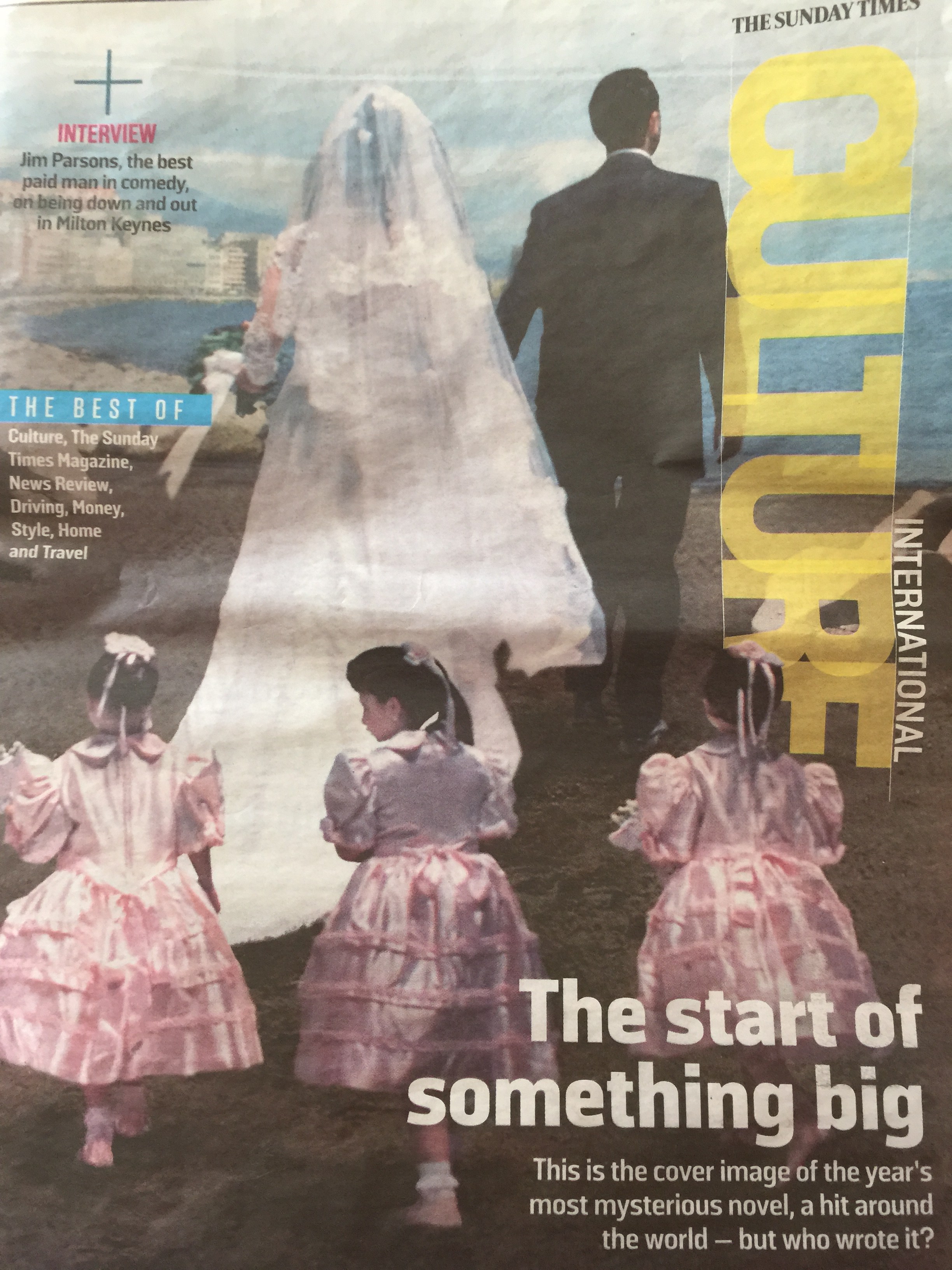
Elena Ferrante Sunday TimesThe unknown great

Elena Ferrante is being acclaimed as a great novelist around the world — but nobody knows who she is, and she’s determined to keep it that way

by Louis Wise – Published: 8 March 2015


In 1991, Sandro and Sandra Ferri, who run a small independent publishing house in Rome, received a manuscript from a new writer. It was called Troubling Love, and it was indeed troubling: a visceral account of a woman’s love-hate relationship with her mother. Equally unsettling, though, was the letter that followed it. The writer, going by the name of Elena Ferrante, explained that she would not be identified. No interviews. No book signings. No pictures on the inside sleeve. Invisible as the author wished to seem, however, the letter was already cut through with a sure and fierce tone. “I’ve already done enough for this long story: I’ve written it,” it said. “If the book is worth something, it should be enough.”

Continue reading →

Jezebel

The Promise in Elena Ferrante
by Jia Tolentino

In a year so crammed with both cultural stasis and accelerated political mania that it resembled nothing else so strongly as a trash fire, there was Elena Ferrante, oasis of the terrifyingly good. The pseudonymous Italian author has made a quiet, graceful transition from cult fame to widespread obsession, and rightly: she’s equally pulpy and brilliant, her plots setting fire to “the female experience” in all its traps and correspondent pleasures while her style accumulates a cold philosophical divinity, increasingly cerebral and bloodless as it becomes bloodier and wild.

At a time where—on the internet, at least—backlash against feminine voices is matched only by women’s insistence on keeping our voice, Ferrante is a third path out of a battle you didn’t expect to find yourself fighting. Her work is more than this, of course, in the way that all great female writers are more than the adjective that still tends to precede them. But I have loved Ferrante’s work this year for one thing in particular: Each of her narrators is a woman whose life has been carved out by other people’s ideas of what a woman should be—let’s call this the original position of “the female experience”—but whose story is defined by violent rejections of this position, a willingness to sacrifice identity to instincts, to shut out all other judgment except for her harsh, dark, freeing own.

Continue reading →

The Millions

A Year in Reading: Charles Finch

By posted at 11:00 am on December 22, 2014 11

I read Elena Ferrante’s Neapolitan trilogy this year.  I read it twice, actually.  It made me want to quit writing.

coverThat sounds like the kind of cutesy thing you could say about any book you love, but in fact the reality of it was terrible, a sensation that lasted for days, a blend of nausea, fog, and loss.  How can I explain it?  Reading those books — My Brilliant Friend, Those Who Leave and Those Who Stay, and The Story of a New Name — it was as if I had spent my whole life training to be a world-class swimmer, waking up at dawn to do laps, eating the right stuff — and then, all of the sudden, swimming in the ocean one day, I had been joined briefly by a dolphin and realized, oh, of course, that’s what swimming actually is.

Continue reading →

Word By Word

My Brilliant Friend tr. by Ann Goldstein

Elena Ferrante is already something of an Italian legend. An author said to spurn interviews, her pen name fuelling speculation about her real identity. Her work is said to be autobiographical and already capturing the attention of English readers in a similar way to the autobiographical series of novels by the Norwegian Karl Ove Knausgaard.

Being a fan of translated fiction I have had my eye on this series for a while and from the reviews and articles I have read, her work reminds me of Caroline Smailes, whose excellent novel The Drowning of Arthur Braxton was my favourite read in 2013.
In 2012, My Brilliant Friend, the first in the trilogy of Neapolitan novels was translated into English and the two subsequent books The Story of a New Name and Those Who Leave and Those Who Stay were published in 2013 and 2014 consecutively.

Continue reading →

Shiny New Books

THE NEAPOLITAN NOVELS BY ELENA FERRANTE

Translated by Ann Goldstein

Review by Lizzie Siddal

Every recent piece about Elena Ferrante seems to begin with the question, who is she?  I’m not about to do that.  The fact that the author, whoever (s)he is, wants to avoid the cult of celebrity and direct attention to the novels is absolutely fine by me.  It’s almost unheard of that I read 3 books by one author in six months, but that’s the truth of 2014. The hashtag is entirely apt.  I have caught #ferrantefever.
It would appear one fix is all it takes and My Brilliant Friend was that fix.  The story of the childhood and adolescence of Elena Greco (Lenu)  and Raffaella Cerullo (Lila), two clever girls, stuck in a poverty-stricken area of Naples during the 1950s, is rivetting. These girls are of my generation and their experience is in some ways similar, though, in most, so far removed from my own.  Reading brought back fond memories from the classroom, teachers who coached and encouraged to greater things, competitions (against those dratted boys) as to who was the cleverest.  The story is narrated by Lenu,  the fortunate one with parents willing to make the monetary sacrifices to keep her in education.  The opportunities of her brilliant friend, Lila, severely restricted by her parents refusal to do the same.  Education will help Lenu escape the claustrophobic small-minded mentality of her neighbourhood. Lila, however, has to rely on her own resourcefulness and sex appeal. Seeing little return for the help she gives to her father’s shoe-making business, she decides to marry the wealthy grocer, Stefano Caracci When local money lenders and bully boys, the Solara brothers, for whom she has nothing but contempt, turn up at her wedding, and are not turned away by her bridegroom, a very mucky dye is cast.
Continue reading →

Harper’s Magazine

THE SECRET SHARER

Elena Ferrante’s existential fictions

By Jenny Turner

Jenny Turner is on the editorial board of the London Review of Books.

Little is known about the writer Elena Ferrante. It’s assumed the name is pseudonymous, but only her Italian publisher could say for sure. From Fragments, a short collection of letters and written answers to readers’ questions, published in 2012, we do gather a few facts: she comes from Naples but no longer lives there, has a classics degree, was once married, and is a mother. These details correspond with the outline of the story she gives to Elena Greco, the narrator of her remarkable novel sequence—My Brilliant Friend (2012), The Story of a New Name (2013), and now Those Who Leave and Those Who Stay—about the friendship between two women born into working-class Neapolitan families in the Forties. In Italy, rumors circulate that “Elena Ferrante” is the work of a male writer, or even writers, an Ern Malley–type hoax. This is not impossible, though if it’s true I feel sorry for the man, or men, behind it. They’ve worked so hard for so long that they must be either sanctified or deranged.

Continue reading →

The New Yorker

WOMEN ON THE VERGE: The Fiction of Elena Ferrante

By James Wood


Elena Ferrante, or “Elena Ferrante,” is one of Italy’s best-known least-known contemporary writers. She is the author of several remarkable, lucid, austerely honest novels, the most celebrated of which is “The Days of Abandonment,” published in Italy in 2002. Compared with Ferrante, Thomas Pynchon is a publicity profligate. It’s assumed that Elena Ferrante is not the author’s real name. In the past twenty years or so, though, she has provided written answers to journalists’ questions, and a number of her letters have been collected and published. From them, we learn that she grew up in Naples, and has lived for periods outside Italy. She has a classics degree; she has referred to being a mother. One could also infer from her fiction and from her interviews that she is not now married. (“Over the years, I’ve moved often, in general unwillingly, out of necessity. . . . I’m no longer dependent on the movements of others, only on my own” is her encryption.) In addition to writing, “I study, I translate, I teach.”

Continue reading →

Vogue

Soul Sisters: Italian Novelist Elena Ferrante’s Mesmerizing Latest, My Brilliant Friend

by Megan O’Grady

October 02, 2012 1:04p.m.


With so many literary heavyweights clamoring for attention this fall, it would be both easy—and a terrible mistake—to miss one more. Italian author Elena Ferrante’s gutsy and compulsively readable new novel, the first of a trilogy, is a terrific entry point for Americans unfamiliar with the famously reclusive writer, whose go-for-broke tales of women’s shadow selves—those ambivalent mothers and seething divorcées too complex or unseemly for polite society (and most literary fiction, for that matter)—shimmer with Balzacian human detail and subtle psychological suspense.

Continue reading →

The Awl Review

Get On The Elena Ferrante Bandwagon

Alex Balk | January 25th, 2013

A little late to this, but James Wood’s recent praise in the New Yorker for Italian author Elena Ferrante’s My Brilliant Friend is absolutely correct, and you should run out and buy the book immediately. DO NOT allow the scary and off-putting fact that it opens with an index of characters to intimidate you. I should also mention, even though it is pretty superficial, that the book (and all of Ferrante’s English translations thus far; I think she was their inaugural author) is published by Europa Editions, who are putting out some of the most interesting titles around in one of the most elegant and simply-designed formats. (Yes, I still read book books; I cannot vouch for their e-whatevers, but these paperbacks are gorgeous. You’re, like, happy to have them in your hand.) Anyway, are you looking for something that you can only put down when you have to look away in the shame and horror of recognition? Elena Ferrante’s for you! It’s going to be such a shame when we find out she’s actually Roberto Calasso or someone.

Shelf Awareness

One of Italy’s most acclaimed authors, Elena Ferrante is not well known in the U.S. My Brilliant Friend, the first in a projected trilogy, may change that. The setting is the outskirts of Naples in the 1950s. Ferrante draws an indelible picture of the city’s mean streets and the poverty, violence and sameness of lives lived in the same place forever.

The story begins in the present day, when 66-year-old Lenù receives a phone call from the son of her lifelong friend, Lila. Decades ago, Lila said she wanted to disappear without a trace; it appears she finally has. Lenù casts her memory back half a century; their friendship began when they walked up a dark flight of stairs to confront Don Achille about stealing their dolls. He is the neighborhood monster, so this foray sets the stage for Lila being the fearless one and Lenù following along, a pattern that repeats frequently over the years. “I did many things in my life without conviction,” Lenù  recalls. “Lila, on the other hand… had the characteristic of absolute determination.”

Continue reading →

San Francisco Chronicle

October 1, 2012


Elena Ferrante is obsessed by disappearance. Her first book, the extraordinary The Days of Abandonment, published in 2002 in her native Italy, opens, “One April afternoon, right after lunch, my husband announced that he wanted to leave me.” By the end of the paragraph, the husband has gone, “leaving me turned to stone beside the sink.”

The book is driven by the narrator’s compulsion to dismantle the husband’s decision, and to determine how she could have known nothing of its origins. Conjuring scenes and conversations, she forces him to reappear, if only in her mind, as she descends into a kind of fever state.

The narrator is preoccupied with solving a marital mystery, that mystery which is the unique agreement – the knowing – between two people; the fortunate reader becomes her captive on this mission.

My Brilliant Friend is Ferrante’s fourth novel, the first in a trilogy, and also obsessed by a most intimate relationship, a friendship. Elena Greco, the narrator, receives an urgent call from Rino, the son of an old friend. His mother, Lila, has disappeared, he says. Elena has known Lila Cerullo since they were little girls in the 1950s, both of them fierce and tortured inhabitants of a destitute Neapolitan neighborhood.

Continue reading →