Time Out New York

#FerranteNightFever

#FerranteNightFever

If you spent your subway rides this year with your nose in one of Elena Ferrante’s heartbreaking Neapolitan novels, you’re not alone. Join other fans at launch parties for her collection of essays, Frantumaglia, and children’s book, The Beach at Night. Head bookstores all over town this week for panels about the author, which include John Turturro, translator Ann Goldstein and other guests.

Bustle

Anonymous Authors Like Elena Ferrante Could Be Onto Something Great

Virginia Woolf once wrote, “While fame impedes and constricts, obscurity wraps about a man like a mist; obscurity is dark, ample, and free; obscurity lets the mind take its way unimpeded. Over the obscure man is poured the merciful suffusion of darkness. None knows where he goes or comes. He may seek the truth and speak it; he alone is free; he alone is truthful; he alone is at peace.” In a capitalist, culture and fame-obsessed country, the concept of obscurity and anonymity are largely forgotten, or viewed only through lens fogged with negativity. To be unknown is to be worthless, we’re told. But perhaps, Woolf, and most recently and controversially, anonymous author Elena Ferrante, were onto something with writing anonymously.

It’s common these days for aspiring novelists to dream of having careers and lives like the universal greats because of their financial and mainstream success — people like J.K. Rowling, Stephen King, Haruki Murakami, James Patterson, or Agatha Christie. We dream of people consuming our words, pulling our characters from the book, and creating and inhabiting a fandom that revolves around, essentially, us. Success is a funny word because it’s impossible to define in just one way. That hasn’t stopped the world from trying, though.

For writers and authors, success means NYT Bestseller, books being made into movies, going viral, Twitter hashtags all about you, and hot takes on your work/words for a whole week. It’s sad, really, because the human attention span has become so abysmal. Like Heidi Klum always says, “one day you’re in and the next day you’re out.” So it is with fashion, so it is with most things.

Part of putting yourself out into the world for mass consumption is that you lose some of your inherent autonomy. You become a product and not a person. Look at Elena Ferrante for example. A sleuth named Claudio Gatti launched a research project and investigation into the true identity of Ferrante. He tried to justify his efforts, explaining to BBC Radio 4, “When millions of books are bought by readers — in a way I think readers acquire the right to know something about the person who created the book.”

Essentially, if you publish a book that millions of people buy, you are then saddled with certain demands and expectations. We are a hungry public and expect our attention and devotion to be rewarded. But in the end, it’s all wrong.

Think the pursuit to discover the ‘real’ Elena Ferrante is a disgrace and also pointless. A writer’s truest self is the books they write.

I’d honestly never considered writing anonymously because it was never presented to me as an option nor as some equivalent alternative to being known. The more you break out of the ego mindset, it seems fairly reasonable and even preferable to write anonymously. You’d be judged for your work and your work alone. You could reach a wider audience, who understandably make not have given your work a chance due to differences in cultural identities. Most importantly, you could hold the power over your career, your art, and your life.

And sure, it’d be nice to have a lot of money and have security for myself and for those I care about. But since when did having money require being famous? Couldn’t you still write articles and novels and screenplays without using your name? This isn’t about bashing people who proudly own their name in their work because there’s immense value in that as well — which I won’t explore right now. This is about presenting a second choice to people who may not have known they ever had one.

Again, I resort to Virginia Woolf, who talked about all of this long ago: “Obscurity rids the mind of the irk of envy and spite; [it] sets running in the veins the free waters of generosity and magnanimity; and allows giving and taking without thanks offered or praise given.”

Perhaps her words here, sum it up best:

“You asked me what I intend to do for the promotion of Troubling Love… You asked the question ironically, with one of your bemused expressions… I do not intend to do anything for Troubling Love, anything that might involve the public engagement of me personally. I’ve already done enough for this long story: I wrote it. If the book is worth anything, that should be sufficient. I won’t participate in discussions and conferences, if I’m invited. I won’t go and accept prizes, if any are awarded to me. I will never promote the book, especially on television, not in Italy or, as the case may be, abroad. I will be interviewed only in writing, but I would prefer to limit even that to the indispensable minimum. I am absolutely committed in this sense to myself and my family. I hope not to be forced to change my mind.

[…]

I believe that books, once they are written, have no need of their authors. If they have something to say, they will sooner or later find readers; if not, they won’t. There are plenty of examples. I very much love those mysterious volumes, both ancient and modern, that have no definite author but have had and continue to have an intense life of their own. They seem to me a sort of nighttime miracle, like the gifts of the Befana [a fairy-like character of Italian folklore], which I waited for as a child. I went to bed in great excitement and in the morning I woke up and the gifts were there, but no one had seen the Befana. True miracles are the ones whose makers will never be known; they are the very small miracles of the secret spirits of the home or the great miracles that leave us truly astonished. I still have this childish wish for marvels, large or small, I still believe in them.”

Your work doesn’t need your name to be yours; it’d be yours no matter what. But it could be more without it.

Smartificial Sweetener

Currently Reading

The Story of a New Name by Elena Ferrante – This is Book #2 in the Neapolitan Series, continuing the story and the friendship of Lila and Elena.  Lila is newly married and finds herself essentially a prisoner of her husband.  He doesn’t like her going out or working or interacting with any men.  Elena remains in school, furthering her education.  The girls vacation together on the coast for the summer, where Lila falls into a relationship with Elena’s crush, cheating on her husband.  Elena herself loses her virginity that summer, in an unlikely way.  As in the first novel, we see the strength of female friendship, the blatant misogyny that all the women in the story must suffer, and the hope that education gives them.  Excited for Book #3!

The Week

In Frantumaglia, Elena Ferrante exquisitely chronicles her own self-erasure

Lili Loofbourow

Last month the literary world exploded over an Italian journalist’s claim to have discovered the “true identity” of Elena Ferrante, the critically acclaimed pseudonymous author of seven novels including her masterpiece, the Neapolitan Quartet, a novel in four volumes that became an international bestseller.

Ferrante had remained pseudonymous for 25 years, resisting awards and publicity and conducting any business her publisher deemed necessary — including long exchanges with two directors who adapted two of her books into films — in writing. That correspondence, along with interviews, unsent letters, and other documents, was collected, and has just been translated into English and published as Frantumaglia: A Writer’s Journey.

The attention economy spares no one, but it’s especially cruel to women who try to opt out of it. “Outside of my books what am I? A woman not unlike many others,” Ferrante wrote. “Forget about authors, then: Love — if it’s worthwhile — what they write. This is the meaning of my little polemic.” But her decision not to self-promote or accept attention was seen in some quarters as insufferably self-aggrandizing or worse, a marketing ploy. Did she really deserve the right to privacy? Didn’t granting interviews at all erode her professed desire for self-erasure?

The journalist responsible for her outing subscribed to the latter view: He cited Frantumaglia as his justification for tracking her down through her financial records. Ferrante’s latest work purported to be autobiographical, he said, and she sacrificed her right to privacy by lying in it. The lies were as follows: Her mother was not a dressmaker. Nor did the woman he identified as being the real Ferrante have the number of sisters Ferrante claimed to have had growing up. It was in the public interest to correct these egregious misrepresentations.

These are weak claims, not just for their pettiness (and vindictiveness — “she was able to use every possible tool that social media provided without paying any price for it. And make money off it, too,” the man who outed her groused), but for how fundamentally they seem to misunderstand what Frantumaglia is up to.

The word itself, frantumaglia, is defined a number of times throughout the book. Here are a couple definitions — and they collectively describe what the book is better than I can:

  • “Bits and pieces whose origin is difficult to pinpoint, and which make a noise in your head, sometimes causing discomfort.”
  • “The frantumaglia is the part of us that escapes any reduction to words or other shapes, and that in moments of crisis dissolves the entire order within which it seemed to us we were stably inserted. Every interior state is, ultimately, a magma that clashes with self-control, and it’s that magma we have to try to describe, if we want the page to have energy.”

The rollicking volume positions itself as something between an afterword, an appendix, and an archive. There’s not much apparent craft to its assembly. It’s a roughly chronological collection of Ferrante’s correspondence with various people and publications. As such, it’s sometimes repetitive, sometimes frank, generally brilliant, and sometimes — especially when she’s being asked for the umpteenth time to justify her decision to remain pseudonymous — irritable.

It’s also, in a very quiet, Calvinoesque way, funny. Ferrante peppers her interviews with hints (even citing Calvino) that she’s not to be taken too seriously — that “Elena Ferrante” is a construct. “You ask me about influences, a question I find so appealing that frankly I risk telling lies just to confirm your hypothesis,” she writes to one interviewer in 1995. Elsewhere, she suggests that “Ferrante” is a character invented to satisfy the readers who require her:

If there is a blank space, in terms of social or media rituals, which for the sake of convention I call Elena Ferrante, I, Elena Ferrante, can and should exert myself — am obliged by my curiosity as a novelist, by the craving to test myself — to fill that empty space in the text. How? … The author, who outside the text doesn’t exist, inside the text offers herself, consciously adds herself to the story, exerting herself to be truer than she could be in the photos of a Sunday supplement.

As if that weren’t a clear enough sign that the author considers “Elena Ferrante” a part of the work rather than a straightforward expression of the reclusive self, she tells Frieze magazine that her favorite title is The Artist is Present because of the way it reverses expectations: “I admire the reversal that Marina Abramović imposed on a formula that I once detested. The artist is present, but as body/work.”

That last bit is key: That the artist is the body/work might well be Ferrante’s rallying cry. But she goes further. Having established her admiration for Abramović and implied that Ferrante the artist is, like Ambramović, part of the work — having firmly woven her own authorial persona into the work, in other words — she answers Frieze‘s perfectly innocent follow-up question (“What do you like the look of?”) by slyly praising the simple boundaries she constantly muddies: “I belong to the ranks of those who feel attracted to anything that is enclosed within a frame, partly because it helps me to imagine what has remained outside it.”

That playfulness doesn’t mean that the disclosures Ferrante makes in Frantumaglia are without value. Quite the contrary. Ferrante may be reclusive, but she’s not evasive; if anything, her point seems to be that a work’s essential honesty is more a matter of art than a matter of fact. “Whatever piece of reality enters a story has to reckon with literary truth, which is a truth different from that of Google maps,” she writes.

Frantumaglia is not exempt; the book is itself more interested in literary truth than it is in Google Maps. It’s worth pausing to examine her “lie” that her mother was a dressmaker to think a little harder about why she told it.

In an essay that started out as a set of answers to questions from two women at Indice magazine and metastasized, Ferrante reflects on the literary history of “cities of ladies” and how she came to love Dido, whose suicide she resented as a girl. (A recurring theme in Frantumaglia is how, to a young Ferrante, literary greatness seemed inescapably male. Another recurring theme — and this is relevant — is her contempt for the male literati who dismiss female writers with “ironic insults.”)

Here is the offending passage — the falsehood about her mother that cost Ferrante her privacy:

And here I should tell you that my mother was a dressmaker for a long period of her life, and that was important for me. With needle, thread, scissors, fabrics she could do anything. She altered old clothes, made new ones, sewed, unsewed, let out, took in, made tears invisible with skillful mending. Because I had grown up in the middle of all that cutting and sewing, the way Dido tricks the king of the Gaetuli immediately convinced me.

Dido (I promise this is relevant) was the founder of Carthage, but her back story is crucial: Her father, the King of Tyre, died and left his kingdom to her and to her brother Pygmalion equally. Pygmalion took over, so Dido married her uncle Acerbas. Pygmalion heard Acerbas had a secret fortune, so he had him murdered to try to seize it. An understandably irritated Dido decided to spite her brother: She arranged to have Acerbas’ “fortune” thrown into the sea as an offering. (It was actually just bags of sand.) After that bit of stagecraft, she escaped to the coast of North Africa, where she asked the Berber king Iarbas for some land.

Here is how Ferrante continues the above passage:

Iarbas had said to her mockingly: I’ll give you as much land as the kind of a bull can go around. Little, very little, an ironic male insult. The king — I was sure, not for nothing was he the son of Amon — must have thought that even if the bull’s hide was cut into strips it would never surround enough land for the construction of a city. But I had seen the fair-haired Dido in the same concentrated pose as my mother when she worked — beautiful, her black hair carefully combed, her skilled hands scarred by wounds from the needle or the scissors — and I had understood that the story was plausible. All night (crucial labors are carried out at night), Dido had been bent over the hide of the beast, reducing it into almost invisible strips, which were then sewed together in such a way that the seams couldn’t even be guessed at, a very long Ariadne’s thread, a ball of animal skin that would unroll to enclose a vast piece of African land and, at the same time, the boundaries of a new city. That seemed to me true and had excited me.

In sum: This is a parable about how women’s work can take a male gesture of dismissal — an insult — and turn it into an empire by refining the bull’s hide into a dressmaker’s thread. It is a matrilineal literary lineage. It is Ferrante-the-writer’s genesis story. And it is about a woman defining her own boundaries as just as expansively as she can. It is a land grab.

It is also, of course, a literary figure. It may not have been literally true, but it arguably explains quite a bit more about Ferrante’s intellectual formation than whatever her mother’s real job was.

It might be argued that creating a literary genealogy is a slightly different thing than erasing the self. Ferrante would agree, I think: She sometimes describes Ferrante as a construction, but it’s no secret that her work is full of women engaged in their own erasures, and those aren’t quite the same thing. Frantumaglia whips back and forth between these modes. If the value of constructing an author is a very particular kind of novelistic intimacy, the value of erasure, Ferrante says, is “to remove oneself systematically from the cravings of one’s own ego, to the point of making it a way of life.”

The problem of the ego seems especially acute around 2003, when Ferrante — who tends to keep politics separate from literature — accepted that there was a political dimension to her thinking about the “I.” Berlusconi’s outsize television personality was changing the character of Italian politics, and his exceptional ego was symptomatic of the danger of letting your name become your caricature. “I am interested in understanding the fact that everything in life is turning into a show,” Ferrante wrote then, “draining the very concept of citizenship.”

I’m also struck by how the person is more and more unhappily dedicated to becoming a personage. And it frightens me that a classical effect of fiction — the suspension of disbelief — is becoming an instrument of political domination in the very heart of democracies. It seems to me that for now Berlusconi embodies, more completely than Reagan or Schwarzenegger, the change taking place in the democratic election of representatives.

There are other facets to self-erasure, of course. Disappearance can be a surrender, she says, thinking of some of her characters, “but it’s also, I think, a sign of their irreducibility. I’m not sure.”

Its main value, however, is creative:

Today what I fear most is the loss of the completely anomalous creative space I seem to have discovered. It’s not a small thing to write knowing that you can orchestrate for readers not only a story, characters, feelings, landscapes but the very figure of the author, the most genuine figure, because it’s created from writing alone, from the pure technical exploration of a possibility. That’s why either I remain Ferrante or I no longer publish.

It’s painful to realize, reading that last sentence, that this might be all the Ferrante we’ll ever get. Luckily, it’s a magnificent jumble of insights, reactions, and philosophical play. Those invested in Ferrante’s work will find much that is beautiful and exquisite and polished in Frantumaglia, and some that feels ephemeral or grouchy or mundane. Somehow I find the last bits more intimate. It helps, sometimes, to see the brushstrokes. Asked about the first work of art that made an impression on her, Ferrante mentions Caravaggio’s The Seven Acts of Mercy. But, she says,

the first piece of art that really mattered to me — I say this only half in jest — was the shape of a watch a childhood friend would make on my wrist by biting it. It was a game. Her teeth left a circle on my skin that I would look at, pretending to tell the time, until the circle faded away. Except I didn’t pretend: I really thought it was a beautiful watch.

The injury done to Ferrante is still new; it’s fresh enough that we’re still in the unusual position of being able to enjoy the fading watch for the lovely thing it is, regardless of its accuracy.
Elle

10 Books to Read in November

There’s nothing like queueing up a stack of reads as November takes us into the holiday season. Bookmark any of these new titles for your upcoming travel plans or deserved time off. We’ve got novels by bestselling authors, translations of international cult favorites, a charming book of illustrations, and more.

Frantumaglia by Elena Ferrante

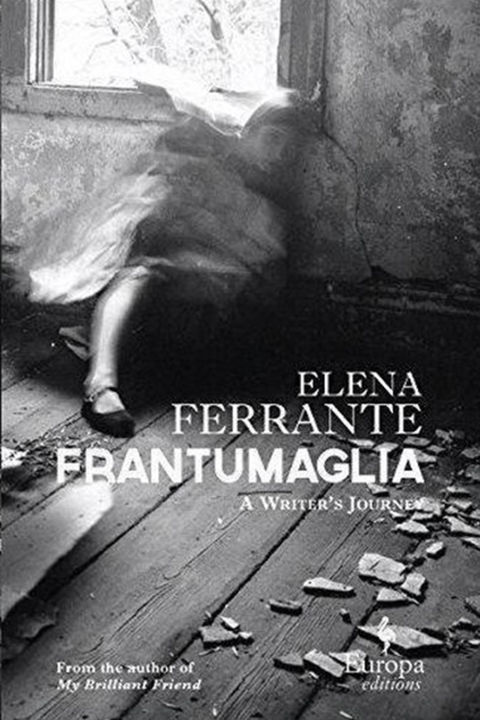
If you’re craving more Ferrante after finishing the Neapolitan series, this collection of interviews, essays, and letters by the notoriously mysterious author will fill the void. Read in her own words why she’s avoided the spotlight and peek into the processes she employs to create her intense literary worlds. (Europa Editions, November 1)

Lit Hub

16 BOOKS YOU SHOULD READ THIS NOVEMBER

I developed Ferrante Fever relatively late. You have to read these books, the Internet kept saying, but for a long time I didn’t read them. Those books with the little girls on the covers that look like Hallmark cards? I said, Sure, I’ll get around to it. I wondered if perhaps the hype stemmed largely from Ferrante’s refusal to promote herself in an age of gluttonous self-promotion. Then I read them. It did not. For me, her books surpassed expectation, coming across less like Jane Austen, to whom she has been compared, and more like Austen’s angrier, more insightful sister—telling it like it is while drunk on fables and feminism. Her plainspoken storytelling not only propels you forwards through many hundreds of pages, but shocks you with a kind of private recognition that, in its freshness, feels revelatory. This month, Europa gives fans two new books by the author that lie on opposite ends of the Ferrante spectrum: Frantumaglia: A Writer’s Journey presents fragments of Ferrante’s (still pseudonymous) real-life letters and personal writings, while The Beach at Night—a “children’s book” that is most definitely not for children, about a forgotten doll—is a fever dream of a fairy tale in the old tradition, where inanimate objects possess feelings and desires in a world thrumming with danger and quotidian violence.

–Summer Brennan (Lit Hub contributor)

DNA Info New York

Where to Catch Ferrante Fever in New York City

 The famous Italian author has two new books coming out on Nov. 1. 

UPPER WEST SIDE — “Ferrante Fever” is here, with city bookstores planning to make the most of fans’ enthusiasm through release parties and talks this November.The upcoming release of two new books by famed Italian author Elena Ferrante has re-ignited what’s been dubbed #FerranteFever on social media, an excitement that’s taken hold among her readers. (There’s even a documentary with the same name in the works.)

Ferrante’s new books — “Frantumaglia,” a self-portrait made from her letters, essays and interviews, as well as her children’s book “The Beach at Night,” told from the perspective of a doll that features prominently in her novels — will hit bookstands at the stroke of midnight on Halloween night.

The craze was initially set off by Ferrante’s Neopolitan series of four novels set in Italy and published between 2012 and 2015. The series chronicles the life of narrator Elena, her complicated relationship with her childhood best friend Lena and how they are both shaped by a changing society.

The final installment in the series, “The Story of the Lost Child,” came out in September of last year.

Ferrante’s wish to remain anonymous and the debate over her identity has stoked the fire.

At a pair of Book Culture outposts on the Upper West Side, Ferrante’s books have been best sellers, said event manager Cody Madsen.

In 2015, “The Story of the Lost Child,” was the fourth best-selling book at the Columbus Avenue location and the third best-selling book at the West 112th Street store, he said.

The release party for the two new books, which kicks off at 11 p.m. on Oct. 31, marks an opportunity for fans to celebrate with Prosecco and Italian snacks, said Madsen, who expects a crowd of 40 to 60 people.

“Everybody can share in the camaraderie around one of our bookstore’s best-selling and beloved book series,” he said.

The registers will open at midnight.

“It’s great when a runaway bestseller is also great book, which isn’t always the case,” Madsen said.

But it’s not just Big Apple fans that are getting into the spirit, as 64 bookstores across the country are holding release events, said Rachael Small, publicity director for the books’ publisher, Europa Editions.

DNAinfo has rounded up the best NYC opportunities to catch Ferrante Fever:

 Ferrante's new books,

Ferrante’s new books, “Frantumaglia” and “The Beach at Night” are coming out on Nov.1.

Europa Editions

Elena Ferrante Midnight Release Party
Book Culture: 450 Columbus Ave.
Oct. 31, 11 p.m.
This party will feature light refreshments and starts at 11 p.m., with registers opening for book sales at midnight.

Ferrante Night Fever Live
McNally Jackson: 52 Prince St., SoHo
Nov. 1, 7 p.m.
A panel of writers — including Roxana Robinson, Dayna Tortorici and Ayana Mathis, as well as Ferrante translator Ann Goldstein and Europa Editions editor-in-chief Michael Reynolds —will discuss the new books.

Ferrante Night Fever!
Community Bookstore: 143 Seventh Ave., Park Slope
Nov. 3, 7 p.m.
Join a celebration at Community Bookstore with a discussion moderated by author Darcey Steinke that will feature actor John Turturro, critic Judith Thurman and professor Giancarlo Lombardi.

#FerranteNightFever
Astoria Bookshop: 31-29 31st St., Astoria
Nov. 4, 7 p.m. to 8 p.m.
Enjoy a glass of wine, commune with other fans and listen in on a discussion with Ferrante translator Ann Goldstein, journalists Jennifer Maloney and Elissa Shappell, and author Siddhartha Deb.

#FerranteNightFever
Book Court: 163 Court St., Cobble Hill
Nov. 5, 7 p.m.
Europa Editions’ editor-in-chief Michael Reynolds will moderate a discussion with writers Emily Stokes, Lisa Lucas, Ann Goldstein, Summer Brennan and Stacey d’Erasmo, with an audience Q&A session to follow.

The Times

The Beach at Night by Elena Ferrante

Reviewed by Alex O’Connell

The Italian novelist Elena Ferrante’s first children’s book, translated beautifully and uncompromisingly by Ann Goldstein, is a dark tale with a complex girl-doll heroine and a malevolent male baddie for brave little readers.

It’s narrated in the first person by Celina, the favourite talking doll of Mati, a five-year-old girl — referencing the doll belonging to Elena that her “brilliant friend” Lila drops through a grate at the start of the Neapolitan Quartet.

Here Celina is on a beach. She has been upstaged in her “mother” Mati’s affections by Minù the cat, a present from her father.

In the heat of the day and the excitement of the new, the little girl leaves Celina behind, half-buried in the hot sand. So begins the doll’s odyssey as the sun sets: “The Beach Attendant arrives. His eyes, I don’t like his eyes. He folds up the big beach umbrellas, the chaises, I see the two halves of his moustache moving over his lip like lizards’ tails.”

If that’s not bad enough, he has a Big Rake for a friend and sings menacingly: “Open your maw/ I’ve shit for your craw/ Drink up the pee/ Drink it for me.”

Charlie and Lola this ain’t.

The Mean Beach Attendant of Sunset finds Celina and plans to pull out her words with his Hook (hello, nursery feminism! Or is it a nod to the author’s supposed “outing”?) and sell her on the market. He makes do with her name and lights a fire on the beach that melts her fellow victim, plastic Pony.

Yet before Celina burns, the Wave comes and she is saved — but also pulled underwater, a pyrrhic victory until the soft mouth of the Dark Animal picks her up.

It is her nemesis, Minù, who will return her to Mati — and Ferrante delivers what is surely her first truly happy ending.

Mara Cerri’s illustrations are weird and wonderful and my gang, 12, 9 and 3, were all hooked by this peculiar tale of loss and rediscovery. Classic Elena for beginners and their Ferrante-fevered parents.
The Beach at Night (5+) by Elena Ferrante, translated Ann Goldstein, illustrated by Mara Cerri, Europa editions, 40pp, £9.99

The New Yorker

What an Ugly Child She Is

By ,

The following essay was drawn from “Frantumaglia,” a collection of Elena Ferrante’s writings and interviews, translated by Ann Goldstein, which is out November 1st from Europa Editions. The central passages were originally conceived as a response to the Swedish publisher Brombergs, which, after acquiring the rights to “The Days of Abandonment,” decided not to publish it, on the ground that the behavior of Olga, the novel’s protagonist, toward her children was morally reprehensible.

France for me—long, long before Paris—was Yonville-l’Abbaye, eight leagues from Rouen. I remember crouching inside that place-name one afternoon, when I was barely fourteen, travelling through the pages of “Madame Bovary.” Slowly, over the years, thousands of other names of cities and towns followed, some near Yonville, others far away. But France remained essentially Yonville, as I discovered it one afternoon decades ago, and it seemed to me that at the same time I came upon the craft of making metaphors and upon myself.

I certainly saw myself in Berthe Bovary, Emma and Charles’s daughter, and felt a jolt. I knew that I had my eyes on a page, I could see the words clearly, yet it seemed to me that I had approached my mother just as Berthe tried to approach Emma, catching hold of her par le bout, les rubans de son tablier (“the ends of her apron strings”). I heard clearly the voice of Madame Bovary saying, with increasing annoyance, “Laisse-moi! Laisse-moi! Eh! Laisse-moi donc!” (“Leave me alone! Leave me alone! Won’t you leave me alone!”), and it was like the voice of my mother when she was lost in her tasks or her thoughts, and I didn’t want to leave her, I didn’t want her to leave me. That cry of irritation of a woman dragged away from her own bouleversements, like a leaf on a rainy day toward the black mouth of a manhole, made a deep impression on me. The blow arrived right afterward, with her elbow. Berthe—I—alla tomber au pied de la comode, contre la patère de cuivre; elle s’y coupa la joue, le sang sortit (“fell at the foot of the chest of drawers, against the brass fittings; she cut her cheek, it began to bleed”).

I read “Madame Bovary” in the city of my birth, Naples. I read it laboriously, in the original, on the orders of a cold, brilliant teacher. My native language, Neapolitan, has layers of Greek, Latin, Arabic, German, Spanish, English, and French—a lot of French. Laisse-moi (“leave me alone”) in Neapolitan is làssame and sang (“blood”) is ’o sanghe. It’s not so surprising if the language of “Madame Bovary” seemed to me, at times, my own language, the language in which my mother appeared to be Emma and said laisse-moi. She also said le sparadrap (but she pronounced it ’o sparatràp), the adhesive plaster that had to be put on the cut I’d gotten—while I read and was Berthe—when I fell contre la patère de cuivre.

I understood then, for the first time, that geography, language, society, politics, the whole history of a people, were for me in the books that I loved and which I could enter as if I were writing them. France was near, Yonville not that far from Naples, the wound dripped blood, the sparatràp, stuck to my cheek, pulled the stretched skin to one side. “Madame Bovary” struck with swift punches, leaving bruises that haven’t faded. All my life since then, I’ve wondered whether my mother, at least once, with Emma’s words precisely—the same terrible words—thought, looking at me, as Emma does with Berthe: C’est une chose étrange comme cette enfant est laide! (“It’s strange how ugly this child is”). Ugly: to appear ugly to one’s own mother. I have rarely read-heard a better conceived, better written, more unbearable sentence. The sentence arrived from France and hit me right in the chest, it’s still hitting me, harder than the shove with which Emma sent—sends—little Berthe against the chest of drawers, against the brass fittings.

The words entered and emerged from me: when I read a book, I never think of who has written it—it’s as if I were doing it myself. So as a child I didn’t know the names of authors; every book was written by itself, it began and ended, it excited me or not, made me cry or made me laugh. The Frenchman named Gustave Flaubert came later, and by then I knew quite a lot about France: I had been there not only thanks to books and not happily, as in books; I could measure the true distance between Naples and Rouen, between the Italian novel and the French. Now I read Flaubert’s letters, his other books. Every sentence was well shaped, some more than others, but not one—not one ever had for me the devastating force of that mother’s thought: C’est une chose étrange comme cette enfant est laide! In certain phases of my life, I’ve imagined that only a man could conceive it, and only a man without children, a peevish Frenchman, a bear shut up in his house honing his complaints, a misogynist who thought of himself as both father and mother just because he had a niece. In other periods, I’ve believed, angrily, bitterly, that men who are masters of writing are able to have their female characters say what women truly think and say and live but do not dare write. Today, instead, I’ve returned to the beliefs of early adolescence. I think that authors are devoted, diligent scribes, who draw in black and white, following a more or less rigorous order of their own, but that the true writing, what counts, is the work of readers. Although the page of Flaubert is in French, Emma’s laisse-moi, read in Naples, has Neapolitan cadences, the brass fittings make ’o sanghe gush from Berthe’s cheek, and Charles Bovary stretches the child’s skin by sticking ’o sparatràp on it. It’s my mother who thought, but in her language, comm’è brutta chesta bambina (“How ugly this child is”). And I believe that she thought it for the same reason Emma thinks it of Berthe. So I’ve tried, over the years, to take that sentence out of French and place it somewhere on a page of my own, write it myself to feel its weight, transport it into the language of my mother, attribute it to her, hear it in her mouth and see if it’s a woman’s phrase, if a female really could say it, if I’ve ever thought it of my daughters, if, in other words, it should be rejected and erased or accepted and elaborated, removed from the page of masculine French and transported into the language of female-daughter-mother. That is the work that truly leads to France, juxtaposing sexes, languages, peoples, eras, geography.

A version of this essay was published by Uitgeverij Wereldbibliotheek, of Amsterdam, in the 2004 anthology “Frankrijk, dat ben ik,” under the title “Het gewicht van de taal,” “The Weight of Language.” It also appeared in the Italian newspaper la Repubblica, in 2005.

Vanity Fair

Ferrante for Kids, The Harvard Lampoon’s Best, and More Books to Read This Month

It’s the most wonderful time of the year. Unless you’re a doll. The Beach at Night (Europa) is Elena Ferrante’s children’s fable (first published in Italian almost a decade ago). The story is narrated by Celina, a doll who also appeared in Ferrante’s novel The Lost Daughter. Forgotten by her owner, Mati, Celina must spend the night facing the solitude and terrors of an unfamiliar world, all while grappling with her jealousy over Mati’s new kitten. Because this story is for children, all will be sewn up neatly in the end. But because it’s Ferrante’s conception of childhood, we won’t get there without a little heart pummeling. Nothing says “holiday cheer” quite like abandonment issues.

New Republic

Elena Ferrante, Private Novelist

In her new book, the anonymous author assembles the fragments of her 24-year struggle to assert her own identity.

BY ALEXANDER CHEE | CONSTRUCTION BY STEPHEN DOYLE

One of my first memories of the publishing industry is the story of a friend who was asked to provide an author photo to help sell the international rights to her debut novel. My friend is not a person who thinks particularly of her looks—she has always focused on her writing. She submitted a photo of herself standing in a doorway wearing a winter coat. The Italian rights sold, the French did not. Her agent, also a woman and a veteran of the industry, joked that perhaps the French would have gone for the rights if the photo had been more revealing. “The lesson I took,” my friend told me, “was that I was being vetted for physical attractiveness”—not the value of her novel.

The author photo is something writers agonize about. Should you smile? Should you seem remote or accessible? Should you lose weight? It is the prelude to the public life of a book: the tours, readings, interviews, and media appearances a writer hopes to undertake on her publishing journey. A writer spends so much of her time subordinating her personal life to write fiction, and then suddenly, on publication, the personal life is all that matters. I recently listened to an interviewer ask a very famous author about a scene in her new novel, how it surely resembled the recent death of her father. As the author began to answer in earnest, I turned the radio off. I couldn’t bear to hear it.

FRANTUMAGLIA: A WRITER’S JOURNEY by Elena FerranteEuropa Editions, 400 pp., $24

The bar for every writer of fiction is that the novel is an invented thing. And yet each time we write, novelists are treated like spiritualists who rip off the grief-stricken—as though our inventions are some sort of hustle. Surely you must have some experience like this: Tell us about it. On tour for my first novel, a reader asked, “How much of this is autobiographical?” I replied, nearly snarling, “If you knew, would you believe it more or less?”

Elena Ferrante wanted none of this. Her career as a writer—now in its third decade—is anonymous, her name a pseudonym, her face unknown. “Elena Ferrante was born in Naples,” reads the author bio on the inside flap of her internationally bestselling novels. The only word readers can reliably identify any part of her work with is Naples. There is no author photo. Since her 1992 debut,Troubling Love, was published in Italy, Ferrante has rebuffed in-person interviews, bookstore readings, lectures, television appearances, award banquets—anything, really, known to sell a book these days. She has communicated through her publishers for more than 24 years, during which she has published seven books. Her last four are considered a single novel, her masterpiece—The Neapolitan Quartet—an unparalleled examination of a friendship between two women in Naples: their marriages, pregnancies, ambitions, jealousies, rivalries, and loves, as well as the past 60 years of Italian history. Despite her refusal to appear in public, the books have sold 1.2 million copies in the United States since they were first published in English in 2012.

In Ferrante’s novels, women disappear quite often—either at the hands of others or by their own will. Disappearance is a way to fight back against the demand that, as women, they must forgo any right to their humanity in service to their families. It is an act of rebellion against the idea of what women should be—an idea usually determined by men. Ferrante’s characters are similar in the way sisters, or women of the same family, are similar: the abandoned wife, the drowned woman, the daughter who imagines she will not meet the fate of her mother, the mother who longs to throw off the yoke of the child.

Ferrante’s latest book to be published in English, Frantumaglia: A Writer’s Journey, is also about a woman’s disappearance—her own. In it, Ferrante records her 24-year fight against the manipulation of her authorial identity. Just before finished copies of the book were sent to reviewers, the Italian journalist Claudio Gatti announced that he had proof of Ferrante’s “real” identity. After scrutinizing financial records and real estate transactions, Gatti said, he had identified Ferrante as Anita Raja, a literary translator who works for Ferrante’s Italian publisher, Edizioni E/O. The New York Review of Books announced the news in a blog post at one o’clock in the morning—the late hour due to its simultaneous publication in the French, German, and Italian presses—as if Gatti had caught a spy.

In Italy, the news was received with a shrug: The naming of a Ferrante suspect had become such a common occurrence, it seemed as though everyone in Italy might take a turn. But readers in the rest of the world denounced Gatti’s actions as a violent unmasking. In The Times Literary Supplement, Frances Wilson condemned it as a “catastrophic misunderstanding of what criticism is or how reading actually works.” Gatti, Wilson said, had actually done readers a disservice: “No one,” she insisted, “really wanted to know the identity of Elena Ferrante.”

In Frantumaglia, Ferrante seems to anticipate her own discovery: The book is like a mask hidden beneath a mask, ready to be displayed when the first one is torn off. Organized with the care of an Italian archaeological museum, it is not meant as an introduction to Ferrante’s work—she even calls it an afterword. Frantumaglia is Ferrante for the Ferranteans, her readers who have long enjoyed the puzzle over her work and her self without ever needing it solved. The reader is meant to enter through her novels, then dive deeper here, into this mix of letters to fans, imagined conversations, interviews with the press, essays—there is even a short story—and come out the other side with no clear answers, only more questions.

Frantumaglia resists any narrative or forward motion. As an unreliable and at times unsympathetic narrator, Ferrante constantly interrupts herself with addenda, footnotes, and postscripts. The book is not a diary, a memoir, or an autobiography. Rather, the fragmentary nature aids Ferrante’s hiding of herself, and like any fragmented narrative it describes something that could not be described if the parts were whole. Through this diffraction, we see what Elena Ferrante wants us to see: A portrait, elided and mercurial, that she asks us to believe is her.

“My mother left me a word in her dialect that she used to describe how she felt when she was racked by contradictory sensations that were tearing her apart. She said that inside her she had a frantumaglia, a jumble of fragments.” Ferrante explains the curious title of her work in an autobiographical essay near the beginning of the book, one of the few glimpses she gives her readers of her childhood, and of her mother—a woman who springs instantly to life, like the mothers in many of her novels. “The frantumaglia . . . depressed her. Sometimes it made her dizzy, sometimes it made her mouth taste like iron. It was the word for a disquiet not otherwise definable, it referred to a miscellaneous crowd of things in her head, debris in a muddy water of the brain.” A few sentences later, we arrive at Ferrante’s own sense of the word:

It’s also the right word for what I’m convinced I saw as a child—or, anyway, during that time invented by adults that we call childhood—shortly before language entered me and instilled speech: a bright-colored explosion of sounds, thousands and thousands of butterflies with sonorous wings.

Childhood is a theme Ferrante returns to again and again in her novels—she identifies intensely with the way a child grapples with words, how children shape and create their selves in a slow accumulation of thoughts, words, and experiences. This vision of her interior, and the sense of how it came from her mother’s interior, is some of her most beautiful writing, consistent with her sense of inheritance from the past. It’s a glimpse into a life not unlike the one we might have imagined for her, consistent with the world of her novels, and deeply satisfying to those readers who would know her.

In another fragment, an interview in the Italian newspaper L’Unita, Ferrante is asked whether her novels originated as private writing, which she vigorously rebuffs. “I write so that my books will be read,” she insists. One of the most startling illusions with Ferrante, novel to novel, is the sense of being admitted to the deeply private thoughts of her narrators—it is part of why her fans love her. But for women, private writing can be considered noncanonical behavior—silly, tragic, self­-indulgent. Ferrante is not a diarist, and her stated desire to remove herself from that kind of condescension is one of Frantumaglia’s openly stated themes.

The book is divided into three sections. In the first section, entitled “Papers: 1991–2003,” Ferrante is still in the first flush of her career, the sort of idealist you would meet in an introductory writing class who believes she is a pure artist, and is obsessed with the pleasures of the written word. She opens Frantumaglia with the document that is now ground zero to her pseudonymous legacy, a letter to her editor refusing all publicity, refusing any appearances of any kind, agreeing only to do a few interviews, and only in writing: “I am absolutely committed in this sense to myself and my family. I hope not to be forced to change my mind.”

In the second section, “Tesserae: 2003–2007,” Ferrante is past her first two novels, and has begun to settle into her own story. In an interview from 2003, she is more placid and professorial, and gives many details about herself. She describes herself as having a degree in classical literature, and states that she works as a scholar, translator, and teacher. She admits to having lived in Greece for some time, as rumored, but says she has returned to Italy and remains entirely Neapolitan, “in my gestures, my words, my voice, even when I put an ocean between us.” When the interviewer asks why she believes nothing in an author’s personal history is useful to better understanding the author’s work, she gives one of her best replies:

I think that, in art, the life that counts is the life that remains miraculously alive in the works.. . . Neither the color of Leopardi’s socks nor even his conflict with the father figure helps us understand the power of his poems. The biographical path does not lead to the genius of a work; it’s only a micro-story on the side.

But the interviewer still hounds Ferrante about her “true” identity, as if he might catch her in a written interview. In the process, he fails to ask her even a single question about her novels. In a 2006 interview, he suggests that “the problems of your identity often overshadow the literary questions,” and asks how she can prevent that. Her answer shows her disappointment.

You ask me how to keep people from talking only about who I am, and neglecting the books. . .. Certainly you—forgive me—aren’t doing anything to reverse the situation and confront what you call the literary questions.

The events of Ferrante’s life are in the background of all of her interviews, visible only if she is asked about them. A decade ago, the Italian press published a series of pieces asserting that she was a man, and interviewers began to ask whether she recognized something “non-female” in her writing. “I’m afraid I learned to write by reading mainly works by men and constantly redoing them,” she responds. “It took time for me to learn to love women writers.” She had earlier referred to these allusions in a more sidelong, provocative way: “I’ve believed, angrily, bitterly, that men who are masters of writing are able to have their female characters say what women truly think and say and live but do not dare write.”

By now, Ferrante has learned to take the media’s attempt at gossip and turn it back to the work. Her continued withdrawal is a refusal to be consumed by all the duties of a woman in public—to seize instead what she sees as this masculine power to write what women truly think and live and do not dare write. This sets her apart from other pseudonymous women writers of the past, who often hid behind male names in order to get published. Elena Ferrante has established the boundaries of a complicated creative space that she is determined to protect at all cost.

“Letters: 2011–2016,” the final section of Frantumaglia, gives us Ferrante as best-selling author—cagey, bored, at times terse, at times expansive. In her Paris Review interview, she entirely avoids the “who are you?” question, and instead focuses richly on her work. Many of these recent interviews are a pleasure to read—Ferrante’s professorial side is less didactic, more relaxed. But when asked, “Will you tell us who you are?” she answers: “Elena Ferrante. I’ve published six novels in 20 years. Isn’t that sufficient?” At this point, I have to agree. Why aren’t the novels enough?

But for all of her explanations on the topic of her withdrawal, the press appears, in these pages, determined to misunderstand her. If she seems repetitive at times, she is—but only because the questions are. Soon, she begins to sound like someone pleading for her life. At one point, she vows to stop publishing if she is exposed. And when she is asked to consider the legacy of her absence, she points a finger home:

Those who became aware of the books later . . . as a result of the media attention, at least here in Italy, encounter them with an initial distrust, if not hostility, as if my absence were an offensive or culpable type of behavior. . .. The only thing I can do is continue my small battle to put the work at the center.

The final conversation in Frantumaglia is conducted amid difficult straits: Both Ferrante and her interviewer are up for one of Italy’s top literary prizes. What remains unmentioned is that there were protests from the jury about Ferrante’s anonymity, as if she might be stealing the prize if she were to win—she was even accused of being a virtual competitor. La Repubblica, which fought the hardest for her to reveal herself, ran a campaign to support her inclusion. But as an editor there explained to me, her decades of refusals had taken a toll. “Many in the literary world in Italy,” he told me, “never forgave her anonymity.”

Naples, 1992. Ferrante feels the city “in my gestures … my voice”—but the translator now suspected of being Ferrante left Naples at age three. Ferdinando Scianna/Magnum

To anticipate her name was to anticipate a certain disappointment. In n+1 last year, Dayna Tortorici satirized the American speculation of a Ferrante unmasking:

Whenever I hear someone speculate about the true identity of Elena Ferrante . . . a private joke unspools in my head . . . She’s Lidia Neri. She’s Pia Ciccione. She’s Francesca Pelligrina. Domenica Augello. Different names every time, but the reaction is the same: a momentary light in the listener’s eyes that fades to bored disappointment. An Italian woman from Naples, whose name you wouldn’t know. Who did you expect?

And now, according to Claudio Gatti, she’s Anita Raja. To find her, Gatti followed the money: How else, he asked, could a literary translator like Raja have afforded a “2,500 square foot, eleven-room apartment on the top floor of an elegant prewar building in one of the most beautiful streets of Rome . . . with a value estimated between $1.5 and $2 million”? Raja and her husband, Domenico Starnone, have both previously been identified as Ferrante, and both have denied it.

It was an astonishing feat—not Gatti’s dig through public records, but that an esteemed literary review conspired in what can be seen as an act of violence against the imaginative country of a major author, the one act she has said would result in her ending her career. Hugh Eakin, The New York Review of Books editor who worked with Gatti, defended the choice to The New York Times. “Now that an expanded version is about to be published in English,” he said, “it seemed there was a legitimate occasion to inquire about the relation between the book and its author.” Was her crime, then, merely to publish Frantumaglia in English?

Frantumaglia is a book created in the spirit of an author’s legacy, less a memoir than a memento mori. As I read it, I was reminded of the intense pruning J.D. Salinger didof his own work, blocking publication of his uncollected stories—which included imperfections that would have worn down his legacy. But as I continued, Frantumaglia began to seem more like Vladimir Nabokov’s Strong Opinions, his collection of his interviews and op-eds, where he even edited the questions as well as his answers. These authors were fanatically in control of their bodies of work and their biographies, with good reason: They formed an essential extension of their selves. Ferrante even experiences this as self-care: “In my experience, the difficulty-pleasure of writing touches every point of the body,” she writes in Frantumaglia. “When you’ve finished the book, it’s as if your innermost self had been ransacked, and all you want is to regain distance, return to being whole.”

Gatti has also defended himself against the outcry over his exposé. “Why should lying by best-selling authors to readers who love their work and have a legitimate interest in knowing who the authors are [be allowed]” he insists, “when you don’t allow politicians to lie to their voters?” And yet few readers, if any, have found any value in the knowledge of Gatti’s accusation, including Gatti himself. Despite his claim that he exposed her to help us interpret the novels, he concedes, “There are no traces of Anita Raja’s personal history in Elena Ferrante’s fiction.”

Raja was born in Naples, the daughter of a German immigrant, but her family moved to Rome when she was three. Her ancestors were not among the Neapolitan poor of postwar Italy, but rather experienced Polish pogroms and Nazi persecution. If Ferrante is Raja, and the Ferrante who spent the majority of her life in Naples—the city she has said she feels “in my gestures, my words, my voice, even when I put an ocean between us”—is also an invention, it would mean Frantumaglia is a metafiction, her most experimental text yet, a massive prank on criticism and the media: all of it done to show us how badly we read what we read, how badly women writers are treated, and how badly the press operates. It would mean her mother’s frantumaglia was not verifiably her mother’s; her childhood impressions the impressions of a fictitious child, not necessarily herself. That everything pointing us to some glimpse of her life was just a misdirection, so that the real woman behind Ferrante could remain hidden—and, one day, teach us that it never mattered who she was or where she was from.

As a reader, I never once grudged Ferrante her space—perhaps because, as a writer, I understood it. I typically write best when I feel hidden and anonymous, as though anything could be possible. It was always clear to me that Ferrante’s battle against notoriety was waged, in a sense, for all of us. She wasn’t doing this just for herself—she wants to change the world.

Perhaps Ferrante will treat the “unmasking” as if it never happened. Or perhaps she will move on—a new persona, a new debut, a new audience, a new test of her insistence that only the work matters. We would have no way of knowing Ferrante’s new name. I think she would want it that way.

Near the end of Frantumaglia, Ferrante is asked what battles feminism still has to win. Her answer is revealing:

We vacillate between rooted adherence to male expectations and new ways of being female. Instead, we must fight, so as to bring about change that is profound. This will be possible only if we build a grand female tradition that men are forced to measure themselves against.

The answer suggests her relationship to her own identity, but also to the world. Only when the freedoms she imagines for herself in private are available to all women, she seems to say, can she herself be truly known. In Frantumaglia, Ferrante asserts the most fundamental and important truth of who she is: that she is someone who will do only as she will, and nothing else. That is what is at stake for all women. And the stakes, as Ferrante knows, have never been higher.

The New York Times

Elena Ferrante: Hiding in Plain Sight

Elle Australia

Get To Know Our Book Of The Month

Frantumaglia ELLE book club book of the month Elena Ferrante

We’re headed to Naples this November with Elena Ferrante.

Our Elena Ferrante obsession heads back into overdrive this month as a new book from the enigmatic author appears on shelves. Up until recently, the fact that, in this day and age, a writer of her prestige managed to remain completely anonymous baffled us.

Of course, as Ferrante fans will now know, her apparent identity was exposed by a nosy journalist very recently – but in the interest of supporting our beloved Italian and her right to privacy, let’s not even go there.

Back to Frantumaglia; it offers a rare glimpse into her writing desk – where the Neapolitan Quartet, among other works, was born – and reads like a scrapbook of letters, thoughts, essays and interviews which scratch the surface of the Italian novelist. It’s out November 1st, but you can enter to win it here!

BBC

Benedict Cumberbatch, Tasmin Little, Elena Ferrante

Elena Ferrante, the author of the Neapolitan Quartet, has always insisted that nothing should come between a reader and her books, and regards public interest in her as an unnecessary distraction. Her new book – Frantumaglia: A Writer’s Journey – is a collection of her correspondence and prompted a media storm when it was used as the justification for investigating and revealing her identity. Critic Alex Clark reviews Ferrante’s latest literary offering.

The Guardian

Frantumaglia: A Writer’s Journey by Elena Ferrante review – astute, revelatory ruminations

A detail from an illustration in Elena Ferrante’s new children’s book, The Beach at Night.
A detail from an illustration in Elena Ferrante’s new children’s book, The Beach at Night. Photograph: Mara Cerri/Europa Editions

Like some bloodhound on the trail of Berlusconi or a mafia magnate, the Italian journalist Claudio Gatti recently unearthed financial documents suggesting that the pseudonymous novelist Elena Ferrante, author of the acclaimed Neapolitan novels, was really a translator with little link to Naples except through her husband.

To many of her readers, the outing felt like a violation, and not only of authorial privacy. It also gave off a sweaty odour of macho politics. Rumours had long travelled the Italian circuit suggesting that no woman could be both so brilliant and so popular a writer: ergo Elena must be a man. Now, by linking his “real” Elena to a well-known Neapolitan writer-husband, Gatti had reinforced that rumour.

The finger-pointing revelations have been denied. But the fact that they have preceded the publication of a new book of reflections, letters and interviews, by just a few weeks, shadows one’s reading of it: your eyes linger a little over the passages that state or assume a childhood in Naples, that ponder truth and lies. Such is the polluting power of journalistic innuendo – as our tabloids have long known.

Ferrante’s insistence on staying out of the stranglehold of celebrity culture has been to avoid this scrutiny. The reduction of a book to its author and spurious autobiography is one of the recurring themes in her interviews, never conducted in person. “Lacking a true vocation for ‘public interest’, the media,” she writes, “would be inclined, carelessly, to restore a private quality to an object that originated precisely to give a less circumscribed meaning to individual experience. Even Tolstoy is an insignificant shadow if he takes a stroll with Anna Karenina.” And Shakespeare’s plays will remain great whether we know for certain or not that he sported a beard and travelled to Italy.

A stand against a system that transforms thinking citizens into swayable audiences – embodied in Italy by Berlusconi, politician and media mogul in one – is only one of the strands of Frantumaglia. The title itself is rich in that layered Ferrante-lore which has made her books a passion for reading women, as well as men. The word comes from her mother, of course. She used it to describe a disquieting jumble of fragments that tore her apart and depressed her, a mysterious “debris in a muddy water of the brain” that woke her in the night and made her weep for no immediate reason.

The child Elena didn’t understand the word, but now, with the accrual of experience, Ferrante associates it with that growing buzz of sound before speech comes into being. Gathering associations, the jumble rumbles on to become both “a storehouse of time without the orderliness of history” and the deeply buried conflicts that engender suffering for her heroines. Frantumaglia is a spur to the writing through which Ferrante frees herself from that very state – as do her first heroines, Delia in Troubling Love, Olga in The Days of Abandonment, and in my eyes the greatest and most chilling, Leda in The Lost Daughter, who, without knowing how or why, steals a little girl’s doll on the beach, thereby fracturing a life. This very doll makes a haunting comeback in Ferrante’s newly translated children’s book, The Beach at Night. She is now the voice of the narrative – an uncanny embodiment of Ferrante’s preoccupations.

Heroines who observe themselves vigilantly, though at times they break down and can’t; mothers; daughters and their troublesome porous, ever changing bodies; children; female friends and the vagaries of love – these are Ferrante’s most compelling subjects. Thinking about her characters in Frantumaglia, she engages in astute, at times dream-like ruminations: on clothes and their link to mother’s body and smell; on figures like Dido, whose tragic abandonment and loss of love lead to fury and the destruction of a city; on her very own beast in the nursery – or, in this case, the storeroom of childhood. Desperate to feed her little sister to a huge fly, she wants also to rescue her. She ends up feeling guilty, both for wanting her sister dead and wanting to save her. Moral ambiguity is fundamental to Ferrante’s universe.

The ambiguity extends to her understanding of feminism – which is, after all, the product of female humans, not always any more rational than their male counterparts. Asked by an interviewer whether the struggle for equality has increased the distance between men and women, Ferrante – brought up in a milieu where “foul-mouthed”, victimised mothers were desperately in love with males and male children, and herself a feminist since the 1970s – writes:

“Female expectations became very high. The behavioural models that made the sexes mutually recognisable, unfortunately, were torn apart and couldn’t be mended, nor has a radical redefinition of mutual satisfaction been possible so far. The greatest risk now is female regret for the ‘real men’ of bygone days. Every form of male violence should be fought against, but the female desire to regress should not be neglected. The crowd of women who adore the sensibility and sexual energy of the worst male characters in My Brilliant Friend illustrate this temptation.” So, one might speculate, do the crowd who adore Donald Trump.

This is a fascinating volume, as ever beautifully translated by Ann Goldstein. At times, it is as absorbing as Ferrante’s extraordinary fictions and touches on troubling unconscious matter with the same visceral intensity. For those who can’t wait for the next Ferrante fiction to sink into, it provides a stopgap. There are perhaps one or two interviews with wordy interviewers too many. But occasional repetitions are outweighed by the insights into Ferrante’s writing process, her love of story above the fine, polished style so prized in contemporary Italian fiction.

I had no desire at all at the end to know who the real Ferrante is. I feel I already know. Frantumaglia has added to that knowledge and also offered up some unexpected gems. I was delighted to learn that she has long been interested in painterly Annunciations, in just how an artist imagines the moment when Mary puts aside the book she’s reading. “When she opens it again,” Ferrante comments wryly, “it will be her son who tells her how to read.”