The New York Times

Scant Clues to a Secret Identity

Elena Ferrante, Author of Naples Novels, Stays Mysterious

Sandra Ozzola and Sandro Ferri of Edizioni E/O, the Italian publisher of Elena Ferrante’s books. Credit Chris Warde-Jones for The New York Times

ROME — The Italian writer Elena Ferrante’s gripping novels about the rich and complex lives of women — as mothers, daughters, wives, writers — have won her a devoted cult following. After several years of growing critical favor, her readership reached new levels this fall with the release of “Those Who Leave and Those Who Stay,” the third volume in her series of Naples novels, which recount the lifelong friendship of two women.

In her most extensive interview in years, Ms. Ferrante, who publishes under a pseudonym and has never revealed her identity, addressed her choice of anonymity — or “absence,” as she called it. In an interview conducted by email and through her publisher, she disputed the oft-circulated notion that she might be a man. “My identity, my sex, are found in my writing,” Ms. Ferrante wrote in Italian in response to written questions conveyed by her longtime Italian publisher, Sandra Ozzola Ferri, who said the writer had declined to grant an in-person interview.

Continue reading

The New York Review of Books

Italy’s Great, Mysterious Storyteller

by Rachel Donadio


donadio_1-121814.jpg
Magnum Photos

Naples, 1964; photograph by Bruno Barbey


There is a devastating exchange in The Story of a New Name, the second of three—soon to be four—books in Elena Ferrante’s masterful Naples novels, in which Lila, one of the two main characters, runs into her former schoolteacher, Maestra Oliviero, on the street. To the teacher’s dismay, Lila, now in her late teens, did not continue her education after elementary school, in spite of her fierce intellectual promise, and is now married and has a small son. The maestra ignores the child, Rino, and looks only at the book Lila is carrying. Lila is nervous. “The title is Ulysses,” she says. “Is it about the Odyssey?” the teacher asks.

“No, it’s about how prosaic life is today.”

“And so?”

“That’s all. It says that our heads are full of nonsense. That we are flesh, blood, and bone. That one person has the same value as another. That we want only to eat, drink, fuck.”


Continue reading

New Statesman

In her secret life: who exactly is Elena Ferrante?

As Ferrante’s writing became conspicuous, so did her anonymity. Speculation gathered, not just about her identity but even her sex.

My Brilliant Friend; The Story of a New Name; Those Who Leave and Those Who Stay 
Elena Ferrante; translated by Ann Goldstein
Europa Editions, 336-480pp, £11.99

When Ann Goldstein’s admirable translation of Elena Ferrante’s novel Those Who Leave and Those Who Stay appeared a few weeks ago, the publishers held a celebration in a small London bookshop. There was wine, pizza and a panel discussion on the theme: “Who is Elena Ferrante?”

The question is one that preoccupies Ferrante’s readership and it has come to haunt the author in ways that are presumably the reverse of what she intended when she decided that personal anonymity was the best way to serve her fiction. Before the publication of her first novel, Troubling Love, in 1991, Ferrante wrote to her Italian publisher, “I do not intend to do anything forTroubling Love . . . that might involve the public engagement of me personally. I’ve already done enough for this long story: I wrote it. If the book is worth anything, that should be sufficient.”

Continue reading

Publisher’s Weekly

Publisher’s Weekly Best-Books 2014

Those Who leave and Those Who Stay

Elena ferrante, trans. from the italian by Ann Goldstein (Europa)

Ferrante’s series of Neapolitan novels has cemented its place as one of the greatest in modern fiction.

This third installment, which follows the evolving and complicated relationship between girlhood friends Elena and Lila, is the best so far.

The Guardian

Elena Ferrante: the global literary sensation nobody knows


She shuns publicity and her identity is a mystery. Yet, as the last in her acclaimed series of novels about two friends in Naples is published, Elena Ferrante’s reputation is soaring, with Zadie Smith, James Wood and Jhumpa Lahiri among her fans. Meghan O’Rourke on a literary mystery

Meghan O’Rourke

The Guardian,


Italy. Cesenatico. 1960.
‘Never has female friendship been so vividly described’ … Italy. Cesenatico. 1960. Photograph: Erich Lessing / Magnum Photos


Continue reading

Who is the real Italian novelist writing as Elena Ferrante?

As the fame of the Those Who Leave and Those Who Stay author grows, so does the guessing game about her identity

in Rome

The Guardian,


Elena Greco knows what it is to be a writer with a public face. She knows the thrill of her name in print and the satisfaction of telling the doubters back home: I did it. But she also knows the pitfalls of tying one’s identity to a tell-all novel: the facile media, the unkind critics, and the cringing embarrassment of old friends trawling through the “dirty bits” with raised eyebrows and judgmental zeal.

Greco, however, is a fictional character, the narrator of a three – soon to be four – novel series about the lives of two young women in postwar Italy. In stark contrast to her fictional heroine, the writer who created her shuns the limelight completely, to the extent that no one, except a handful of people close to her, knows who she is. Over the past two decadesElena Ferrante – a pseudonym, of course – has become one of her country’s most exciting and compelling contemporary literary voices. And, as her celebrity grows, so too does the guessing game surrounding her identity.

Continue reading

Lizzy’s Literary Life

Meet the translator: Ann Goldstein

Later today Issue 3 of Shiny New Books will appear and, with it my ruminations on the first three Neapolitan novels of the phenomenon that is Elena Ferrante. To coincide with that, Ann Goldstein, who works as an editor at The New Yorker and translates Ferrante’s novels into English, talks here about her career as a translator, the third and most recently released Neapolitan novel and her desert island books.
How did you become a literary translator?

Somewhat by accident. An Italian manuscript came to The New Yorker, where I am an editor, and at the time I was the only person who could read Italian; the idea was that I would read it and then write a polite rejection. But I decided to translate it, and it was published in the magazine. The manuscript was Chekhov in Sondrio by Aldo Buzzi (September 7, 1992).

Continue reading

Shiny New Books

THE NEAPOLITAN NOVELS BY ELENA FERRANTE

Translated by Ann Goldstein

Review by Lizzie Siddal

Every recent piece about Elena Ferrante seems to begin with the question, who is she?  I’m not about to do that.  The fact that the author, whoever (s)he is, wants to avoid the cult of celebrity and direct attention to the novels is absolutely fine by me.  It’s almost unheard of that I read 3 books by one author in six months, but that’s the truth of 2014. The hashtag is entirely apt.  I have caught #ferrantefever.
It would appear one fix is all it takes and My Brilliant Friend was that fix.  The story of the childhood and adolescence of Elena Greco (Lenu)  and Raffaella Cerullo (Lila), two clever girls, stuck in a poverty-stricken area of Naples during the 1950s, is rivetting. These girls are of my generation and their experience is in some ways similar, though, in most, so far removed from my own.  Reading brought back fond memories from the classroom, teachers who coached and encouraged to greater things, competitions (against those dratted boys) as to who was the cleverest.  The story is narrated by Lenu,  the fortunate one with parents willing to make the monetary sacrifices to keep her in education.  The opportunities of her brilliant friend, Lila, severely restricted by her parents refusal to do the same.  Education will help Lenu escape the claustrophobic small-minded mentality of her neighbourhood. Lila, however, has to rely on her own resourcefulness and sex appeal. Seeing little return for the help she gives to her father’s shoe-making business, she decides to marry the wealthy grocer, Stefano Caracci When local money lenders and bully boys, the Solara brothers, for whom she has nothing but contempt, turn up at her wedding, and are not turned away by her bridegroom, a very mucky dye is cast.
Continue reading

The Independent

Paperback reviews: Those Who Leave and Those Who Stay, Before the Fall, Into the Trees, Million Dollar Arm, Floating City

Those Who Leave and Those Who Stay by Elena Ferrante (Europa Editions £11.99)

Elena Ferrante’s magnificent “Neopolitan novels” trace the relationship between two headstrong Italian women, from their schooldays in the 1950s to the present day. In the first volume, the narrator – who shares the author’s first name – documents how her “brilliant friend” Lila left school to marry a local mafioso while she went on to university; in the second book, Elena becomes a successful novelist while Lila leaves her abusive husband and takes a job at a sausage factory.

This, the third entry in the series, picks up the story in the late-1960s and 1970s. Elena marries a wealthy young scholar and moves to Florence to raise a family, while Lila becomes involved in leftist politics in Naples. They stay in touch, but their relationship is now tinged with envy. Elena finds herself unhappy: her husband is cold, her children difficult. While Lila lives in relative poverty, she seems to Elena to enjoy “absolute freedom”, to wield increasing power as she prosecutes “her wretched neighbourhood wars”. Elena comes to feel restless for her own independence.

Continue reading

New York Magazine – The Cut

Elena Ferrante Is a New Breed of Literary Girl-Crush

By

Photo: FPG/Getty Images

Before the Italian novelist known as Elena Ferrante’s first book, Troubling Love, came out in 1991, she told her publisher she would do no public appearances, accept no awards, and submit only to the minimum interviews, in writing. “I believe that books, once they are written, have no need of their authors,” she wrote at the time.

Ferrante’s books certainly have no need of her: The latest, Those Who Leave and Those Who Stay, published in the U.S. earlier this month, achieved a critical mass of attention (essays in the New YorkTimes and an interview, of sorts, inVogue) without a single publicity photo. “Elena Ferrante,” in fact, is widely assumed to be a pseudonym. But what about her books’ readers? Do we really have no need of the author?

Continue reading

Oprah

BOOK OF THE WEEK

Each week, we’ll let you know about the new releases the editors of O and Oprah.com couldn’t stop reading.

Those Who Leave and Those Who Stay is the third volume in Elena Ferrante’s deliciously addictive Neapolitan series. In an expansive yet intimate feat of storytelling, the three novels narrate the intriguing tale of a pair of women whose lifelong relationship is their touchstone and their burden. We meet Lila and Elena in the first book, My Brilliant Friend, as young girls living in a treacherous working-class neighborhood in Naples in the 1950s. Lila is dazzling—a stunning beauty, self-confident, volatile, at once seductive and dangerous. She shines at school, and the conviction in her small hands when she hurls rocks at bullying boys is unmatched. Elena, who lacks Lila’s fearlessness, crouches in her friend’s shadow. Both girls come from a long line of women held down by poverty and violent men and dream of escaping that fate.

Continue reading

The New Yorker

Out Loud: The Mysterious Power of Elena Ferrante

Last year, James Wood reviewed two novels by the Italian author Elena Ferrante: “The Days of Abandonment” and “My Brilliant Friend,” the first volume in Ferrante’s Neapolitan series, about two women, Lila and Elena, struggling to escape the violence and misogyny of their Naples upbringing. Wespoke back then with Wood and Ferrante’s translator, Ann Goldstein (who is also a New Yorker editor) about those books, and about the mystery surrounding Ferrante’s identity. Since then, two more Neapolitan novels have been published in English: “The Story of a New Name” and “Those Who Leave and Those Who Stay,” which came out in English earlier this month. On this week’s Out Loud, host Sasha Weiss, the literary editor of newyorker.com, speaks with Goldstein and the staff writer D. T. Max—one of many Ferrante devotees atThe New Yorker—about the radical emotional intensity of the series. Max says, of Lila and Elena’s friendship, “I can’t think of a counterpart in British or American letters. It’s so ornery, it’s so fraught, it’s so rich. It’s full of ironies, confusions, back-trackings, moments where you think you get it and then you don’t.”

You can listen to the episode above or by downloading it for free from iTunes. Click here for more New Yorker podcasts.

The Globe and Mail

Italian author Elena Ferrante’s work – startling, unflinching fiction – speaks for itself


A few months ago, I sat in the pool-viewing area of Toronto’s West End YMCA reading My Brilliant Friend, a doorstop of a novel by the Italian novelist Elena Ferrante, while my daughter happily splashed her way through a lesson on the other side of the glass.

Another dad with a kid in the pool approached me, pointed at the book, and asked, with a grin that was frankly conspiratorial: “How are you liking it?” When I replied that I was liking it a lot, he told me, almost whispering, that an Italian friend of his sends him Ferrante’s books even before they get translated: “She is amazing.” I was impressed – as much by the idea of getting novels sent direct from Italy as by the mere fact that he knew who Elena Ferrante was.

Continue reading

Financial Times

Q&A with author Elena Ferrante


‘What book changed my life? Books don’t change your life. If they are good, they can hurt and bring confusion’

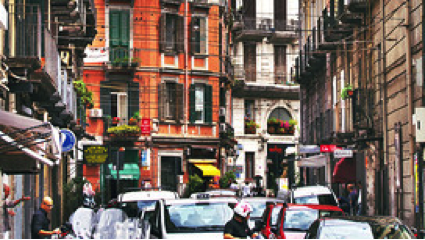
naples

A street view of Naples, where Elena Ferrante was born

Italian writer Elena Ferrante was born in Naples. Her debut novel, Troubling Love (1992), won various prizes in Italy and was made into a film by Mario Martone. The Days of Abandonment (2002) stayed on the Italian bestseller list for a year, and was translated into 19 languages. It was followed by The Lost Daughter (2006) and the loose trilogy My Brilliant Friend (2011), The Story of a New Name (2012) and Those Who Leave and Those who Stay (2013). Ferrante remains incognito.

Who is your perfect reader?

Those who read for the pleasure of reading and fall in love with a text regardless of who is the author.

Continue reading