Hazlitt

‘Be Silent, Recover My Strength, Start Again’: In Conversation with Elena Ferrante

Speaking with the author of the Neapolitan Quartet novels and Frantumaglia about why readers have trouble with challenging portrayals of women, the supposed sin of narcissism, and smoking cigarettes.

I interviewed Elena Ferrante by email over the summer of 2016. This was about a month before the New York Review of Books published a long article by an Italian journalist alleging her “true” identity. She read my questions (which were written in English) and wrote her responses in Italian. Her replies were translated by Ann Goldstein, the English translator of Ferrante’s many books. I had been hesitant about conducting this interview when I was offered the opportunity, for I admire Ferrante’s reticence. Yet, debating it with myself, it seemed it would be a mistake not to ask this great writer questions, if I had the chance.

For those who are unaware, Ferrante is one of the most celebrated contemporary writers in the world, and rightly so. In 2011, she released the first of a series of four books (each around 350 pages in length) called The Neapolitan Quartet, which follow two female friends from the time of their childhood in Naples in the 1950s to the present day. The books thrillingly unmask the consciousness and social situation of these women, tracing the complex bonds and political struggles of several generations of families in twentieth-century Naples. Reading these books, I felt a keen loss over the many great books that had not been written by women down through time; Ferrante made me long for even more first-rate writers to map (and to have mapped) the many underwritten aspects of the female experience. To me, the books have a distinctly female point of view: the point of view not of the natural victor but of one who has to fight for the right to observe.

Her three earlier and shorter novels (Troubling Love, The Days of Abandonment, and The Lost Daughter, published in Italian between 1992 and 2006) are like tinctures of the quartet: exquisitely precise and intensely felt, they magnify moments in a life and are written in a style and language that calls to mind few others—perhaps Clarice Lispector, for being just as brutal, penetrating, and heartbreaking. Ferrante’s books are profoundly contemporary while giving the same satisfaction as many nineteenth-century novels, as if Ferrante were not living in a landscape of busily competing media, but rather writing in a world where the quiet of readers can be taken for granted. She is formally risk-taking yet is a masterful storyteller. Her books rush you along in a swell of complicity, curiosity, feeling, and suspense. I cannot think of a single person I know who has not read Ferrante only to fall helplessly into her world. She has collapsed the gap between the sort of books that writers feel awe for and that the reading public can’t get enough of—the rarest thing.

Speaking personally, as a writer who has engaged in the various publicity and marketing strategies that many of us allow, I was interested to talk to Ferrante about how she knew from the beginning that she wanted to avoid the performance of self. I wanted to ask about how she—as a great illustrator of the human condition—has navigated such experiences as motherhood, discipleship, and rebellion. Naturally, I was curious to know how she wrote her books, but I didn’t ask too many craft questions because I know that for any writer, composition is ultimately a mystery.

Ferrante has managed, for decades, that difficult and enviable thing: the maintenance of total privacy as a human being, along with total openness as a creator through her art. I, and many of her devoted readers, hope there is even more of that art still to come. We are so grateful she took the time to do this interview, although as you will see, she doesn’t consider this an interview at all.

***

Sheila Heti: You’ve remarked that you forget the books you read. Do you think there’s some connection between being a reader who forgets (I am too), and being able to create and write? Maybe forgetting is a subconscious kind of remembering that allows writers to recombine what they’ve taken from literature, in ways that are particular to them.

Elena Ferrante: Yes, that’s probably the case. I do forget, I forget especially the books I’ve loved very much. I have an impression of them, I have a feeling for them, but to discuss them I would have to reread them. If I had a clear memory that allowed me to cite passages, point out crucial moments, any attempt at writing of my own would seem to me lost at the start. Imagination is said to be a function of memory. I prefer to think that it’s a function of nostalgia. We compose stories knowing very well that we are the last to arrive. And yet every time it seems to us that we are returning to the moment when the first human being, with nothing but the truth of his experience and the urge to reinvent it at every step, began to tell a story.

You once said, “I tend to edit and then inevitably revert to the original draft, when I see what I’ve lost by editing.” I agree: there is always some power in the way a person first catches the words on the page. Can you talk about your instinct to keep the rawness with your instinct to clean up? If you often prefer the first draft to the edited draft, what does your editing process consist of?

I detest vapid, sugary, sentimental tones and I try to get rid of them. I detest refinement when it cancels out naturalness, and so I look for precision without going too far. I could continue like that, with a fine list of intentions, but it’s just talk. In fact I move by instinct, a spontaneous movement that, if I put it in order, becomes merely a banal guidebook. So let’s say that, pulled this way and that by countless readings, by varied layers of taste, by inclinations and idiosyncrasies, I generally aim at what seems to me perfection. Then, however, perfection suddenly seems an insane excess of refinement and I return to versions that seem effective precisely because they are imperfect.

Picasso said the new work of art always looks ugly at first, especially to its creator. Did you find your books ugly in the way Picasso meant?

Yes, certainly yes, but not because I feel the book as new; rather, because I feel it as mine, tarnished by contact with my experience.

So much contemporary female writing is accused of narcissism. Have you escaped the charge of narcissism, or have you received it? I’d like to bind this question to your comments about women who “practice a conscious surveillance on themselves” who before were “watched over by parents, by brothers, by husbands, by the community.” You have written that women who practise surveillance on themselves are the “heroines of our time,” but it’s precisely these women—real and fictional—who are accused of the sin of narcissism, as if a woman looking at herself (rather than being looked at by a man) was insulting to everyone. How do you understand this charge?

I’ve never felt narcissism to be a sin. It seems, rather, a cognitive tool that, like all cognitive tools, can be used in a distorted way. No, I think it’s necessary to be absolutely in love with ourselves. It’s only by reflecting on myself with attention and care that I can reflect on the world. It’s only by turning my gaze on myself that I can understand others, feel them as my kin. On the other hand it’s only by assiduously watching myself that I can take control and train myself to give the best of myself. The woman who practises surveillance on herself without letting herself be the object of surveillance is the great innovation of our times.

Your books resist the pressure to be “correct” in a feminist sense. For me, I have noticed that often it’s women who react most negatively to portrayals of women that are “un-feminist.” Why do you think such readers have a hard time with portrayals of women that conflict with their ideals? Do they feel the female author is somehow betraying them?

“Correctness” has never been a concern of mine when I write. Nor have I ever felt, in telling a story, that I had to adapt the story or the character to the demands of a cultural alignment, to the urgent needs of political battles even if I share them a hundred percent. Literature is not the sounding board of ideologies. I write always and only about what it seems to me I know thoroughly, and I would not bend the truth of a story to any higher necessity, not even to some ethical imperative or some prudent consistency with myself.

You’ve said, “Even if we’re constantly tempted to lower our guard—out of love, or weariness, or sympathy or kindness—we women shouldn’t do it. We can lose from one moment to the next everything that we have achieved.” This is very striking to me. What does it mean to you to lower your guard? Women are taught to give ourselves fully, with great trust, in love… but you think we shouldn’t?

It seems to me risky to forget that no one gave us the freedoms we have today—we took them. For that very reason they can at any moment be taken away again. So just that, we mustn’t ever lower our guard. It’s wonderful to give oneself fully to another, we women know how to do it. And we should continue. It’s a serious mistake to retreat, giving up the marvelous feelings we’re capable of. Yet it’s indispensable to keep alive the sense of self. In Naples, certain girls who showed the marks of beatings would say, even with pleased half smiles, He hits me because he loves me. No one can dare to hurt us because he loves us, not a lover, not a friend, not even children.

You’ve said, “I feel such a sense of unease and distrust these days that I can no longer write even half a word without fearing that, once published, it might be distorted or purposely taken out of context and used in a malicious way.” I think this is something many writers feel. Have you found a solution for it?

Yes. Be silent, recover my strength, start again.

Do you smoke cigarettes?

Until a few years ago I smoked a lot, then I stopped abruptly. I tell you this because what is written while smoking seems better than that which fears for its health. But we have to learn to do well without necessarily doing harm to others and ourselves.

Do you keep copies of the books you have written and published in the room where you write?

No.

You’ve written, “A novel about today that is engaging and full of characters and events should be a novel about and against the suspension of disbelief.” How does your work avoid the necessity of the suspension of disbelief, and do you find too many novels are written today that require the suspension of disbelief? If readers are trained to suspend their disbelief, are they less effective political actors on their own behalf?

Those words of mine were a political metaphor. I was referring to what seems to me to have happened in recent decades: the transformation of citizens into a public involved in representations of the world that are skillfully constructed in order to suspend incredulity. The citizen risks acting like a fan, an enthusiastic consumer of media narratives that are plausible but deceptive, because those narratives are not the truth but have the appearance of truth. In other words, we have to return to not believing what they tell us. We have to relearn to distinguish between truth and verisimilitude.

Why do you do interviews? How do you decide which interviews to participate in? Are there rules you follow? Why not let the books exist without the interviews? Are you ever going to stop doing interviews altogether? Why not now?

I no longer follow any rule. The main thing is that it doesn’t seem to me that I’m giving interviews. You think that we’re doing an interview? I don’t. In an interview the person being interviewed entrusts his body, his facial expressions, his eyes, his gestures, the way he speaks—an often-improvised speech, inconsistent, poorly connected—to the writing of the interviewer. Something that I can’t accept. What we are doing resembles, rather, a pleasant correspondence. You think about it and write me your questions; I think about it and write my answers. It’s writing, in other words, and I like/am fond of all occasions for writing. In the past it seemed to me that I was unable to come up with answers suitable for publication. Either they were too succinct, a yes or a no, or a short question became an occasion for reflection, and I wrote pages and pages. Now I think I’ve learned something but not necessarily. So no, I don’t give interviews, to anyone, but I find these exchanges in writing increasingly useful—for myself, naturally. It’s writing that should be placed beside that of the books like a fiction not very different from literary fiction. I’m telling you about myself, but you too—a writer, I read one of your books in Italian, which I loved—with your questions are telling me about yourself. I talk about myself, as do you, as a producer of writing. I do it truthfully, addressing not only you and our possible readers but also myself, or at least that substantial part of myself that considers it completely senseless to waste so much time writing and needs reasons that justify the waste. In short, your questions help me to invent myself as an author, to give form, that is, to this unstable, elusive part that I myself know little or nothing about. Something that I imagine has happened to you too, as an author, when you have formulated the questions.

In Magda Szabó’s The Door, Emerence—the intelligent cleaning-woman with a strong inner code of behaviour, who keeps house for the intellectual woman-writer protagonist—reminds me a bit of Lila, and Szabó’s protagonist is reminiscent of your Elena. Yet Emerence is somehow the superior of the pair, as is Lila. Is there something in the figure of the intellectual woman writer that pales in comparison (from the perspective of the woman writing) to the (comparatively) uneducated woman who yet knows and understands the world? Why do so many female writers demean the “intellectual” female figures we create? Do we still not truly value female literary work, women who work with their minds? Is it a kind of self-loathing? Why do we often portray intellectual women as having lost more than they have gained?

You pose a very interesting question; I have to think about it. Why do we invent cultivated, intelligent women and then lower their level or even their pleasure in life? Who knows. Maybe because we’re still incapable of a convincing portrayal of female intelligence. We haven’t completely set aside the literary model that represented us at the side of a superior man who would take care of us and our children. Thus, though we have now acquired the sense of our inner richness and our intellectual autonomy, we portray them in a minor key, as if our capacity to produce ideas and culture were a presumptuous exaggeration, as if, even having something extra, we ourselves didn’t really believe in it. From here, probably, comes the literary invention of secondary female figures who possess that something extra in themselves, remind us of it, assure us that it’s there and should be appreciated. We are still in the middle of the crossing, and literature makes do however it can.

You write in Frantumaglia that you were the sort of child who “apologized for everything.” But as an adult, you realize that goodness “derives not from the absence of guilt but from the capacity to feel true loathing for our daily, recurring, private guilt.” Yet how can a woman ever truly know what she should be guilty for, when women live in a world of codes that have been created by men; when we live in “male cities” (as you have termed it) and when the route to understanding who one is necessarily involves exploring one’s instincts to “disobey”? How can you tell the difference between what you should feel guilty for and what you are made to feel guilty for but shouldn’t feel guilty for?

Our future depends on this connection. There is no true liberation without a strong sense of self. The systematic practice of disobedience is in fact an integral part of male values, and so doesn’t really free us; rather, at times, it crushes us, makes us even more acutely the victims of men’s needs, especially in the realm of sex. We need an ethics of our own to oppose that which the male world has imposed on and claimed from us. We need a hierarchy of our own of merits and faults, and we need to reckon with truth. But that’s possible only if we consider ourselves to be exposed to good and evil like any human being. When literature represents us as the positive pole of life or as having been exposed to evil only as victims—an evil that in the end will turn out to be a good, if looked at with spectacles different from those imposed by males—it is not doing its duty. The duty of literature is to dig to the bottom. We are a subject not only unpredictable but unknown even to ourselves. We have an urgent need for representation and for an ethics of our own. We have the right and the duty to explore ourselves thoroughly, to slip away, to cross the borders that make us suffer. I insist on self-surveillance, which means choice, assumption of responsibility, and the necessity of losing restraint in order to know ourselves, not lose ourselves.

Did you ever fear what you would lose by not participating in the media, festivals, etc.? How did you set about so confidently not pleasing your publisher? And do you think it’s possible for a writer who has sent herself around in the world as a writer to stop? Or does the fact of ever having been seen mean that something is forever lost and any retreat is useless? Finally, have you ever signed a book?

Yes, I made the mistake of signing a hundred copies, some years ago. It was naïve. It seemed to me that since I was doing it at home, in private, it wouldn’t cost me much. Today I think that I could have spared myself even that. I remain of the opinion that a book has to absolutely make it on its own; it shouldn’t even use advertising. Of course, my position is extreme. And among other things the market has by now absorbed it and made the most of it, while the media have readily changed it to gossip and a puzzle to be solved. But for me the small cultural polemic underlying the choices I made twenty-five years ago remains important. I will never consider it finished, and I trust that no one who feels that writing is fundamental will completely set it aside. Good books are stunning charges of vital energy. They have no need of fathers, mothers, godfathers and godmothers. They are a happy event within the tradition and the community that guards the tradition. They express a force capable of expanding autonomously in space and time.

The complete conversation between Elena Ferrante and Sheila Heti can be found in Brick magazine’s Winter 2017 issue, due out at the end of this month.

Boston Globe

A row of Elena Ferrante books at the Harvard Book Store.

It may be the next best thing to her being there.

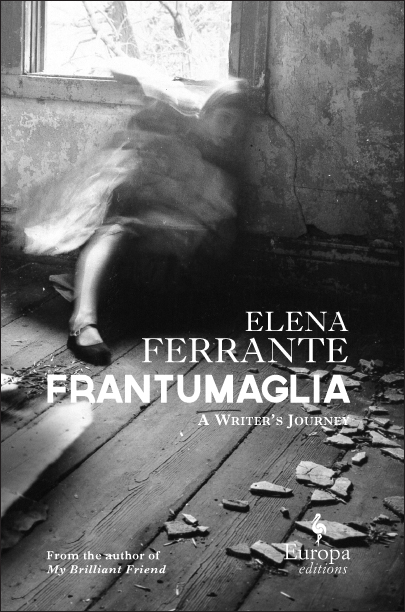
Brookline Booksmith and WBUR have just announced that they will present a conversation on the work of the illusive Elena Ferrante Nov. 29 to mark the publication of Ferrante’s first collection of nonfiction, “Frantumaglia: A Writer’s Journey,” a collection of letters, essays, and interviews conducted via e-mail.

The event will feature Ann Goldstein, Ferrante’s translator; Vogue book critic Megan O’Grady; and Michael Reynolds, editor in chief of Europa, Ferrante’s US publisher. Christopher Lydon, host of WBUR’s “Open Source,” will moderate the discussion.

Ferrante, a pseudonym for an author desperate to remain unmasked, is best known in the United States for four novels called the Neapolitan series, which chronicle a beautiful and difficult decadeslong friendship between two girls from Naples. The books, translated from the Italian, have quietly and unexpectedly become a huge hit among American readers.

The event will take place at Coolidge Corner Theatre at 6 p.m. Tickets are $5, available through Brookline Booksmith.

Brain Pickings

Elena Ferrante on the Myth of Inspiration, Writing on Demand, and the Central Truth of the Creative Process

“Words draw out words: one can always write a banal, elegant, heartfelt, amusing coherent page on any subject, low or high, simple or complex, frivolous or fundamental.”

Elena Ferrante on the Myth of Inspiration, Writing on Demand, and the Central Truth of the Creative Process

“A self-respecting artist must not fold his hands on the pretext that he is not in the mood,” Tchaikovsky proclaimed in a letter to his patron in contemplating how inspiration factors into on-demand creative work.

More than a century later, beloved Italian novelist Elena Ferrante attests to this central truth of creativity in a magnificent letter to her publisher, Sandra Ozzola, included in Frantumaglia: A Writer’s Journey (public library) — the nonfiction volume that gave us Ferrante’s elegant case for anonymity.

September of 1994 marked the fifteenth anniversary of Ozzola’s publishing house, Edizioni E/O, which a couple of years earlier had taken a chance on a young first-time author writing under a pseudonym. Ozzola invited Ferrante to write a short piece commemorating the occasion. Ferrante, noting that to “say no to people whom we love and trust” is not her way, complied in a largehearted letter that begins with a meta-meditation on the creative process itself and ends with a beautiful parable celebrating the occasion. It stands as a testament to the fact that where there is groundwater of genius, the well of inspiration can be dug anywhere and any personal experience can quench the universal thirst for meaning.

ferrante

Ferrante, translated as always by Ann Goldstein (who embodies “that rare miracle when a translation stops being a translation and becomes … a second original”), writes:

Dear Sandra,

What a terrible thing you’ve done: when I happily agreed to write something for the anniversary of your publishing venture, I discovered that the slope of writing to order is a slippery one, and that the descent is in fact pleasurable. What is next? Now that you’ve made me pull out the plug, will all the water flow out through the drain? At this moment I feel ready to write about anything.

Will you ask me to celebrate the new car you’ve just bought? I’ll fish out from somewhere a memory of my first ride in a car and, line by line, end up congratulating you on yours. Will you ask me to compliment your cat on the kittens she’s given birth to? I will resurrect the cat that my father first gave me and then, exasperated by its meowing, took away, abandoning her on the road to Secondigliano. You’ll ask me to contribute an essay to a book you’re doing on the Naples of today? I’ll start from a time when I was afraid to go out for fear of meeting a busybody neighbor whom my mother had thrown out of the house, and, word by word, bring out the fear of violence that reaches us on the rebound today, while the old politics touches up its makeup and we don’t know where to find the new that we ought to support. Should I make an offering to the feminine need to learn to love one’s mother? I will recount how my mother held my hand on the street when I was little: I’ll start from there… I preserve a distant sensation of skin against skin, as she held tight to my hand, out of anxiety that I would slip away and run along the uneven, dangerous street: I felt her fear and was afraid.

[…]

Words draw out words: one can always write a banal, elegant, heartfelt, amusing coherent page on any subject, low or high, simple or complex, frivolous or fundamental.

With this, Ferrante puts her ethos into practice and delivers a most inspired iteration on the assignment:

In one of the many houses where I lived as a child, a caper bush grew, in all seasons, on the wall facing east. It was a rough, bare stone wall, riddled with chinks, and every seed could find a bit of earth. But that caper bush, especially, grew and flourished so proudly, and yet with colors so delicate, that it has remained in my mind as an image of just force, of gentle energy. The farmer who rented us the house cut down the plants every year, but in vain. When he decided to fix up the wall, he spread a uniform coat of plaster over it and then painted it an unbearable blue. I waited a long time, trustfully, for the roots of the caper to win out and suddenly fracture the flat calm of that wall. Today, as I search for a way to congratulate my publisher, I feel that it has happened. The plaster cracked, the caper exploded anew with its first shoots. So I hope that Edizioni E/O continues to struggle against the plaster, against all that creates harmony by elimination. May it do so by stubbornly opening up, season upon season, books like the flowers of the caper.

Complement this particular fragment of Ferrante’s thoroughly satisfying Frantumaglia with Leonard Cohen on creativity and work ethic, Agnes Martin on the nature of inspiration, Carole King on inspiration vs. perspiration, and Elizabeth Gilbert on what Tom Waits taught her about creativity.

Asymptote

On Frantumaglia and the Real Mystery of Elena Ferrante

Nice little stories with happy endings or some kind of moral resolution? Not for La Ferrante!

As an Italophile and an Elena Ferrante fan, I’m thrilled to see her nonfiction work, La Frantumaglia, finally making it into English in the form of Frantumaglia: A Writer’s Journey, published this fall by Europa Editions.

I know the book will intrigue American readers with the backstory of her novels and her life as a writer (I’m also thrilled that the original title has largely crossed the Atlantic intact, particularly given the unusual provenance of the Italian word, “frantumaglia,” which Ferrante culled from her mother’s speech and which she defines as a jumble of ideas or thoughts).

One could nonetheless argue, given the nature of the book—a collection of manuscript drafts, interviews and letters—that it will surely fail to stir up the same excitement as did the Neapolitan series or her earlier novels. This is the author, after all, who launched her novel, The Days of Abandonment,with the line: “One April afternoon, right after lunch, my husband announced that he wanted to leave me.” Boom! Not to mention the creator of the frenzied, passionate scene between Nino and Elena in the bathroom of the house she shares with her husband, Pietro, from Book Three of the Neapolitan quartet (a scene Elena rushes into after rushing out of the arms of her young children). Whoa! How do you top that?

And of course, it’s not like Frantumaglia confirms (or denies) what Italian investigative reporter Claudio Gatti recently sprung on the literary world (if for no other reason than it had already gone to print). Gatti, as anyone remotely following Italian literature knows, believes he has pulled off an expose by studying real estate records and other documents to deduce that Ferrante is actually a translator named Anita Raja. (Edizioni E/o, Ferrante’s Italian publisher, has denied the claims.)

Yet I can confidently say the Ferrante lines that have made the biggest impressions on me are in La Frantumaglia, which was first published in Italy in 2003.

These impressions may have been especially vivid because I read the book in Italian. Indeed, when I think about my relationship with Italian, it sounds almost Ferrantesque. My passion for the language feels like a powerful, titillating, all-consuming obsession. I hear mystery in Italian, and I see mystery in Italy. And Ferrante’s writing especially—including her bold, expansive, presumably candid responses to journalists’ questions in Frantumaglia—reminds me that Italy will remain eternally beguiling (perhaps because it’s the Other for me, as an American).

Many Italian authors have written passages that have left me as breathless as a love letter. In the case of Ferrante, I’m left breathless and with my hand flying up involuntarily to my mouth in shock. Consider how Ferrante shows Olga, the protagonist of The Days of Abandonment, so gripped by potent emotions as she grapples with her husband Mario’s departure that in one chilling scene, she unloads her rage on the family dog. The animal has unwittingly become a nagging reminder of Mario’s flight. She loses her patience with Otto while out for a walk, and begins to strike him mercilessly. As she rains blows upon him, Otto becomes the object of all of her rage as a cuckolded wife. Suddenly Olga stops herself in alarm: she’s taken revenge for Mario’s sin on an innocent creature.

Ferrante depicts her female protagonist not merely contemplating acts of violence, but carrying them out. To be sure, other literary heroines have also lashed out; Medea, in the Greek tragedy of the same name, kills her children. But Medea is conceived as a mad figure. By contrast, Ferrante allows her characters—her female characters—to express rage as a normal course of life. Olga will regret her actions and calm down. The “black frenzy of destruction,” as Ferrante writes, is temporary. She is a fully-realized human being, and like male characters in other works, she sometimes experiences blind rage.

Or take this line from her novel La Figlia Oscura [The Lost Daughter]: “Le lingue per me hanno un veleno segreto.” Languages contain a secret poison for me. Whoa, again. As I said in my MFA graduate lecture earlier this year at Bennington College, leave it to Ferrante to zero in on the insidious nature of something inanimate like learning a foreign language.

Yet despite such arresting moments in her novels, I must confess that the words of Ferrante that have captivated me the most are included in Frantumaglia—something she wrote about writing. The critical revelation comes in a passage where she explains to an interviewer for the Italian newspaper L’Unità that what distinguishes The Days of Abandonment from other books she’d begun writing but pushed aside is that it “stuck fingers in particular wounds of mine that were still infected.”

Wounds of mine that were still infected. I underlined the sentence, then bracketed the paragraph. In my journal, I found myself returning to those words, in the original Italian: ferite [wounds] ancora [still] infette[infected]. As an aspiring fiction writer, I’ve often lamented to my diary, “I’m not writing enough about the ferite ancora infette.”

There are all kinds of other interesting tidbits in the book, and certainly, there’s information in there that one could use to consider Gatti’s hypothesis. But even back before we had any clue about her identity, back when I first read La Frantumaglia, I moved quickly away from any questions about who she was once I got to the part about the festering wounds. In fact, I leapt to this question: do I have festering wounds? And can I exploit them properly through fiction? (I believe this notion would hold for any reader, even those who don’t aspire to write fiction. What are my wounds? Can I identify them? What do they tell me about myself?)

As author Lisa Appignanesi wrote in her review of the book for The Guardian, “At times, it is as absorbing as Ferrante’s extraordinary fictions and touches on troubling unconscious matter with the same visceral intensity. For those who can’t wait for the next Ferrante fiction to sink into, it provides a stopgap.”

In the same 2002 interview with Stefania Scateni from L’Unità, Ferrante says that she’s also written stories that sprang from something like what we in English would call “happy endings,” the part when the slight or the misunderstanding was made right. But she says she then discovered, “Non è quella la mia strada.” As translator Ann Goldstein puts it in her wonderful English translation, “That is not my path.”

I feel a breeze moving over me from the briskness of that statement. Nice little stories with happy endings or some kind of moral resolution? Not for La Ferrante!

Ferrante says something else that left me impressed. She says the need for love is the most fundamental experience of human life, adding that, even though it may seem odd, we are only truly alive when we have “an arrow in our side that we drag around night and day.”

Now I should say something that illuminates these observations but please excuse me, I’m still trying to catch my breath after re-reading that passage I’ve ingested many times, but which continues to stun me for its simple veracity, its profound, almost stubborn insight. I want to write next to it in the margins, “Yes, yes, yes” (or perhaps better, “Madonna, si, si, è vero”).

So what is my point?

Well, with these two passages from Frantumaglia in mind, I come perhaps to the too-tidy conclusion that it doesn’t matter if Gatti is right and Elena Ferrante is really Ms. Raja. Like many others, I’ve always held that what intrigues me most is her writing, and what she will come out with next. But I’m compelled to offer this reasoning especially when considering Frantumaglia.

Whoever she is, this author concluded that her writing springs from personal wounds that are still infected and that the search for love, the desperate need for love, drives all human life, and that person, be it Ms. Raja or someone else, will always have something to say to me, something that I will always want to hear, even if it leaves me gasping.

The real mystery is how this writer evolved, how she came to hold these beliefs and to be able to articulate them spontaneously in an interview and then dramatize them through unforgettable stories and characters.

The mystery for me lies in the exact brain circuitry that imagined Olga in The Days of Abandonment attacking, in addition to the dog, Mario and his lover on the street in broad daylight, with me, the reader, flabbergasted and thrilled at the same time. As Appignanesi notes in her Guardian review, “Moral ambiguity is fundamental to Ferrante’s universe.”

This same mystery, if we were able truly to discover it, would explain how a grown adult can successfully cultivate and insinuate an obsession with dolls into multiple works of fiction (including the Neapolitan quartet and The Lost Daughter), in a way that’s creepy and effective. Childhood, for Ferrante, is every character’s home country—one that can never fully be left behind, and that gives me the shivers as much as any whodunit.

Saying the name Anita Raja (or any other name that may come down the pike from the investigative wing of the literary world) won’t ever fully explain these mysteries, and that is thrilling. Nor will reading Frantumaglia, but, if you’re like me, you’ll enjoy it for that very reason.

Jeanne Bonner is a writer and journalist based in Atlanta, GA. Her creative writing, including nonfiction essays and book reviews, have appeared online at The New York Times, Literary Hub, Catapult,Consequence and Asymptote Journal. She studied Italian Literature at Wesleyan University and has an MFA in Creative Writing from Bennington College.

Shelf Awareness

#FerranteNightFever

More than 60 bookstores across the country staged #FerranteNightFever events last week, a focal point of the November 1 launch in the U.S. of two new titles by Elena Ferrante–Frantumaglia: An Author’s Journey and the children’s book The Beach at Night. Publisher Europa Editions provided participating bookstores with a kit with event ideas, discussion questions, posters, buttons and bookmarks.

Some of the most striking events took place in the New York area. At Community Bookstore in Brooklyn, a lively discussion was moderated by novelist and critic Darcey Steinke and featured actor/filmmaker John Turturro, Ferrante scholar Giancarlo Lombardi and literary biographer/critic Judith Thurman. An international, SRO crowd heard the group discuss Ferrante’s work in the context of the Italian literary landscape; Naples as a fertile territory for storytelling; the film adaptation of Troubling Love; feminism in Ferrante’s work (and why it’s important for men to read these novels), and a comparison of the reception of Ferrante’s work in Italy and the U.S.

At McNally Jackson: Ann Goldstein, Dayna Tortorici, Roxana Robinson

On Tuesday, McNally Jackson in New York City hosted a panel consisting of novelist Roxana Robinson, Dayna Tortorici from n+1 and Ann Goldstein, translator of Ferrante’s work, moderated by Europa Editions editor-in-chief Michael Reynolds, which considered Ferrante’s books (Frantumaglia in particular), her literary influences and her thematic concerns.

On Friday at Astoria Bookshop in Queens, another SRO crowd heard novelists Siddhartha Deb and Elissa Schappell, journalist Jennifer Maloney and translator Ann Goldstein–also moderated by Michael Reynolds–discuss Ferrante’s importance as a feminist writer and her writerly style (her tight sentences and “virile” writing), her approach to class and poverty and the political nature of her work.

Finally on Saturday, Reynolds moderated a panel at BookCourt in Brooklyn with authors Stacey D’Erasmo and Summer Brennan, New Yorker features editor Emily Stokes, National Book Foundation executive director Lisa Lucas and Ann Goldstein, which focused on Ferrante’s writing, how each participant discovered her work and what they find important about it and more. The q&a included an impassioned discussion of the role of dialect in Ferrante’s books.

New Stateman

“Writing is everything and I am nothing”: the vanishing acts of Elena Ferrante

By Alex Clark

Elena Ferrante’s “unmasking” by the journalist Claudio Gatti, whose article on her identity, originally written for the Italian newspaper Il Sole 24 Ore, appeared in the New York Review of Books to the outrage of many of her readers, conformed beautifully to 21st-century type. It was characterised by a quality of sooner-or-later inevitability: a puzzle (of sorts), a period of “mounting speculation”, a touch of frustration, then a revelation that was dull enough for the focus to move on to a debate about its ethics.

I should unmask myself as a Ferrante aficionado. I will never repeat her “real name” – at least, not until she has sanctioned it. I am hopelessly parti pris. For me, Ferrante’s novels were not just an intense aesthetic experience but came to feel like the gateway to a different way of writing and reading, and the assault on her identity was intrinsically tied to her work and to our narcissism. The Neapolitan novels, for example, begin with a woman disappearing: not, in the narrator’s opinion, as a result of an impulse to run away, or through suicide, but to achieve a more complex form of self-erasure. Ferrante’s novels – and her writings in Frantumaglia, a collection of letters, interviews and pieces from 1991 to this year – are an attempt, in part, to explore that impulse.

In common with all of Ferrante’s work, Elena’s and Lila’s intertwined story demonstrates what happens to women as they are slotted into societal roles and fall under the gaze of men and, indeed, other women: how they must invent themselves, politically, socially, sexually, psychically.

The damage of exposure is a constant feeling. In My Brilliant Friend, we learned how Lila suffered episodes of “dissolving boundaries”, moments of panic and dissociation that distanced her from herself and from her supposedly familiar environment. Eventually, what she requires is an entirely private space.

The pieces in Frantumaglia (the word translates as “the act of falling apart”) assert that space over and over again. In her written responses to interviewers’ questions or editors’ letters, or her exchange with Mario Martone, who wrote the screenplay for the film adaptation of her novel Troubling Love, she is precise, continually dissecting queries and weighing her words. Her one-off pieces (many of them previously unpublished), about subjects including an adaptation of a Joseph Conrad short story and how Flaubert shaped her conception of France, are thoughtful and suggest acute self-editing. Yet there also is her love of pure story, from those of Dido and Aeneas and Madame de La Fayette’s 1678 novel La Princesse de Clèves – her “closest companion” when she was writing The Days of Abandonment – to tales that appear in popular magazines. Always there is the tacit refusal to be reduced. In one response to a critic, Ferrante describes “a somewhat neurotic desire for intangibility”.

She repeatedly returns to a sentence from The Andalusian Shawlby Elsa Morante: “No one, starting with the mother’s dressmaker, must think that a mother has a woman’s body.” Ferrante is discussing the way that maternal bodies are made shapeless, unsexed, but she also links this to the limitations placed on the maker: “I had imagined scissors that refused to cut, measuring sticks that lied about length, basting that didn’t hold, chalk that didn’t leave a mark. The mother’s body produced a revolt among the dressmaker’s tools, an annihilation of her skills.”

This ambivalent attitude towards making – the understanding that it can be creation, appropriation or even destruction – underpins Ferrante’s work. The realism of her scenarios – the streets and slums of Naples, the airy riverside apartments of Turin, the vagaries of employment, education, marriage and divorce in postwar Italy – sits alongside elemental dramas that more closely resemble the psychodramas of the fairy tale. In The Days of Abandonment, a woman cooks dinner for her faithless husband to try to win him back but accidentally serves him a shard of glass that embeds itself in his palate; in the Neapolitan novels, Elena’s mother dies and bequeaths her daughter a limp.

It is perhaps the power of that combination of the banal and the mystical that requires the private space. Keats, Ferrante notes, declared that he had no self or identity beyond that of a poet, “that he is whatever there is that is most unpoetic”. “In general,” she muses, “one reads that letter of his as an announcement of aesthetic chameleonism. I on the other hand see in it an untying in which the author boldly separates himself from his writing, as if he were saying: writing is everything and I am nothing, address it, not me. It’s a disruptive position.”

Whatever the facts of her life – whether she turned out to be an ancient man living in the Icelandic interior or a woman waiting tables at a Texan diner – Ferrante writes in an autobiographical mode. That is fuel for the truthers, a sort of literary ankle-flashing. But it is also good cover for another motive: a very contemporary form of envy of another’s autonomous space and their creativity, a rage that while they give us their work, they will not also give us their person. Discomfort, too, that we are not that self-effacing person. As Ferrante points out, she is not anonymous. Her name is on the cover of all her books. We are simply denied the right to penetrate further than that.

An interview in the Corriere della Sera, published in November 2011, ends with a final question: “So will you tell us who you are?” To which the answer is: “Elena Ferrante. I’ve published six books in 20 years. Isn’t that sufficient?”

Frantumaglia: a Writer’s Journey by Elena Ferrante is published by Europa Editions, 384pp, £16.99

Corriere Canadese

Literacy Changes Everything

FERRANTE NIGHT FEVER AT I AM BOOKS

Dear Reader:

Last Thursday, November 3, 2016  was one of the best evenings of my life. I attended the Ferrante Night Fever party at I AM Books, a charming little bookstore in the North End (Boston’s Little Italy) that carries titles written by Italian and Italian American authors. It was a wonderful coincidence that last Thursday was also my 35th birthday, and the occasion was thoroughly enhanced by this particular celebration of my very favorite author – Elena Ferrante.

img_9098

All Saints Way in Boston’s Catholic North End

If you are not familiar with Elena Ferrante and her work, here is a quick Ferrante 101:

  • Elena Ferrante is a pen name, a pseudonym. No one knows the true identity of Ms. Ferrante. Through interviews, Ms. Ferrante claims that she does not want celebrity because she wants more time for her writing, rather than traveling and doing readings.
  • Ms. Ferrante is incredibly popular in Italy, but it has only been in the last few years that she has become well-known in the American market.
  • Elena Ferrante’s most popular works are a series of 4 books known as the Neapolitan Novels. These books focus on the lives of two women, Lenú and Lila,  who have grown up together and whose lives are entangled, even during periods when they do not talk or see one another. These novels are narrated by Lenú, and, despite Lenú’s achievements as a scholar, she always feels inferior to the uneducated yet brilliant and aggressive Lila.
  • All of Ferrante’s novels focus on the lives of women, and they are considered by many readers to be extremely dark.
  • Fans of Ms. Ferrante are livid that an Italian journalist has recently tried to expose Ms. Ferrante’s identity. They feel it is an invasion of her privacy, and they want to protect her from unwanted attention.

I have to say that, at the Ferrante Night Fever party (which, by the way, was completely free of charge), everyone was made to feel like a guest of honor. We were treated to a feast of Italian food – arancini,  meatballs, and amushroom stuffing – as well as  cream-filled pastry horns for dessert.

The crowd of mostly women gathered to celebrate the  release of Ferrante’s Frantumaglia: A Writer’s Journey in its English translation. Unlike her other books, which are novels or novellas, Frantumaglia is a treasury of letters, essays, and interviews that reveal Ms. Ferrante’s writing process. As a writer myself, this book particularly interests me, as I feel it will provide insights to inspire my own process.

I am saving my copy for a Thanksgiving Break read-through, and I look forward to finishing it all in one go. I was on maternity leave when I read Ferrante’s other works (and I have read all of them), and it was wonderful to move through them all in one go. Our family has no firm plans for Thanksgiving, which gives me the gift of time to dedicate to this book.

fullsizerender

My copy of Frantumaglia

At the event, a wonderful Italian journalist (whose name I unfortunately did not catch) not only brought us wine, but he also facilitated an engaging discussion of Ferrante’s work. A key wondering that arose was why Ms. Ferrante’s work was so popular with Americans. One women from Naples suggested that Americans have a love affair with Italy, and many at the gathering agreed. I think this is true about Americans, but for myself, I wouldn’t say I have an infatuation with Italy. For me, the novels stand alone because they are revealing of how women interact and how a female writer and scholar perceives herself, her relationships, and the world. I am particularly interested in the way Ms. Ferrante’s characters separate themselves from their families and feel criticized because of it in order to accomplish scholarly work or inventions.

img_9100

With my dear friend and fellow educator Ms. Gro

As an educator, I connect very strongly with the theme of education and applied  intelligence as a means of gaining freedom from violence and poverty in Ferrante’s work. The Neapolitan novels begin in the extremely raw Naples of the 1950’s. Men beat their wives in public. Women stay indoors nearly all the time. Babies are thrown out of windows. And yet silence is preserved, especially amongst women. Yet Lenú finds success in school, reads vigorously, and she convinces her family to permit her to continue through high school. In contrast, Lila is forced to leave school after the 5th grade to work in her family’s shoe store. Still, Lenú feels she is the inferior “white swan”, technically perfect but she will never rise to the styling of Lila’s “black swan”. Lila is able to invent a famous style of shoe, create a brilliant work of photography, learn computer engineering, and eventually run a successful business with seemingly little effort. Lenú feels clumsy as she joins in intellectual circles with those who have had a far more privileged upbringing than herself. She devotes herself to her writing, and she becomes a successful scholar and writer. Yet Lenú has to make incredible efforts with all she does, and Lila’s achievements are always in the front of her mind.

The Ferrante Night Fever gathering was the first time I had ever attended an book club-style discussion. My reading and writing life is something very personal. While I feel comfortable writing about it, I am far less confident in discussing my ideas with others. This event made me realize how a thorough discussion can aide my understanding of and deepen my connection to literature. I was shy at first, but then loosened up, especially because my dear friend Ms. Gro was with me, and she is the life of any party. I left feeling that it had been the perfect evening…and a perfect birthday celebration.

img_9103

End of the Evening Smiling Selfie with my Ferrante Fever button

I AM Books is the country’s first Italian American Bookstore. It is located at 189 North Street in Boston’s North End. It is open seven days per week. Website: iambooksboston.com

The Hindu

Story of the other writer

Mini Kapoor

I started Elena Ferrante’s Neapolitan tetralogy all jumbled up. A book store had a special order of the Europa editions of her novels in English translation, their fabulous covers being an immediate draw. The final book was not yet out in English, and as is my habit when attracted to an unread series, I started with the second book. (Don’t ask.) It also helped that the editions had cover flaps. (A big takeaway from endless conversations with other readers is that we are divided irreconcilably into two groups, those who adore cover flaps, and those who hate them. I’m a life member of the former, smaller group.) Having judged the books by their covers, and been won over by the endorsements printed within, it seemed that all I needed to know about the writer was on the back flap of the book, The Story of a New Name: “Elena Ferrante was born in Naples. She is the author of…”.

Clues about identity

Having read — inhabited actually — her Neapolitan saga thereafter, it remained just a curiosity that Elena Ferrante was a pseudonym, that she had managed to protect her (some speculated his, arguing that these feminist novels of love and friendship were written by a man) identity through so many books and such success. For the new Ferrante reader, such speculation is diversionary, as you are compelled to swing from one book to the next, till you have read them all, and have in the process become protective about her privacy. Coincidentally, when I finished the books, I was offered a potential interview (it didn’t happen). Excited, I went back to reread her books as homework, and now I could not shake off the temptation to keep a keen eye out for some telling detail so that I could frame questions to get never-before-elicited clues about her identity.

In the time since, an Italian journalist has claimed to have conclusively identified the ‘real’ Ferrante, a well-regarded Rome-based translator called Anita Raja — but back then that second reading was disconcerting, as if the opportunity to interact with Ferrante had taken me away from the deeper reading of her fiction that had been so nourishing. Reading Frantumaglia: A Writer’s Journey (Europa Editions), a collection of her interviews and letters just out in English translation, it’s interesting to see how persistently, almost to the exclusion of much else, she is questioned on identity, and how patiently she answers the question each time, year after year.

She told a Turkish journalist in 2015: “One need only glance at the publishing history of my books to realise that it’s not the absence of the writer that has produced their success but their success that has made the subject of my absence central… what has been surprising is the discovery that those who became aware of the books later, at times as a result of the media attention, at least here in Italy, encounter them with an initial distrust, if not hostility, as if my absence were an offensive or culpable type of behaviour.”

At one point another interviewer asks, “Who is Elena Ferrante? How would you define her?” Ferrante replied: “Elena Ferrante? Thirteen letters, no more or less. Her definition is all there.”

It’s a wonder how many different ways Ferrante answers questions about her resolve to keep her identity secret — there is no resort to stock answers, there is no evasion. As she takes on the question from different angles, interview after interview, it becomes clear that there is more than vanity here in choosing to publish a collection of interviews and writings on her refusal to reveal her identity. To be “Elena Ferrante” is for the author of these beloved novels essential to her craft.

An essential separation

She tells an interviewer in 2002: “I’ve always had a tendency to separate everyday life from writing. To tolerate existence, we lie, and we lie above all to ourselves. Sometimes we tell ourselves lovely tales, sometimes petty lies. Falsehoods protect us… Instead, when one writes one must never lie. In literary fiction you have to be sincere to the point where it’s unbearable, where you suffer the emptiness of the pages. It seems likely that making a clear separation between what we are in life and what we are when we write helps keep self-censorship at bay.”

Who knows what the Italian investigative journalist who went after the income details of writers suspected to be Ferrante really wanted to out. But the fact that so many of her readers were disturbed by this “outing” shows that they — we — had internalised, however incoherently, the need for a separation that made her books possible. Hearing her explain it, interview after interview in one volume, helps.

The Telegraph

Elena Ferrante: how to see an invisible author

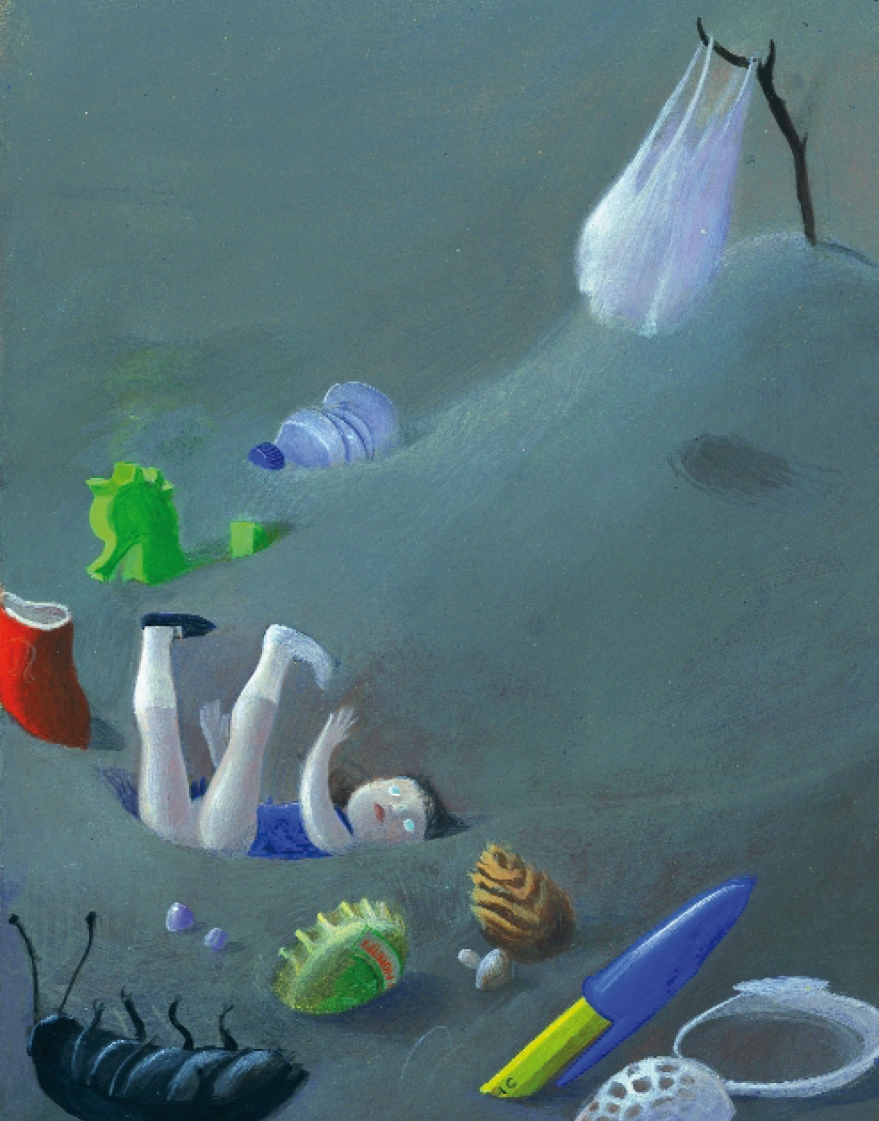
Secret sharer: detail from an illustration, by Mara Cerri, from Elena Ferrante’s new book for children, The Beach at Night

A month after being ‘identified’ in the foreign press, why does the novelist Elena Ferrante remain out of sight?

Last month, the invisible author Elena Ferrante was apparently exposed by an Italian investigative journalist, whose article was published in a number of countries simultaneously. Claudio Gatti claimed that Ferrante – whose four Neapolitan Novels have sold millions of copies worldwide – was in fact a half-German translator named Anita Raja.

He cited as evidence bank records that showed transfers of large sums of money around the time of Ferrante’s greatest successes from her publisher to Raja (the novels were originally published, in Italian, between 2011 and 2014; their English translations followed a year behind). Gatti’s move was so widely criticised that The New York Review of Books, which had accepted the English language version of his article for its website, has since added…

The Australian

Frantumaglia by Elena Ferrante: a life in pieces

Towards the end of The Story of the Lost Child, the final volume in Elena Ferrante’s Neapolitan Quartet, the narrator, Lenu, justifies the narration of the story as an attempt to give her friend Lila ‘‘a form whose boundaries won’t dissolve’’. Lila has suffered acutely from exactly this, a mysterious illness in which the physical boundaries of people and things appear suddenly to erode, the ‘‘thing and the person … gushing out of themselves, mixing liquid metal and flesh’’. She is terrified by this ‘‘dissolution’’, afraid of being ‘‘plunged into a sticky, jumbled reality’’ where she might vanish.

Throughout the four novels Lila is a figure of particular intensity and this malady from which she suffers represents, in concentrated form, the defining ailment and treacherous base condition of the human self that is consistently depicted across all Ferrante’s works, experienced by all her leading women. This condition is frantumaglia.

The term features as the title of Naples-born Ferrante’s new book, the first collection in ­English of her nonfictional pieces, comprised largely of professional letters and interviews since 1991.

As a book of fragments, the title refers to the nature of the contents. But it also speaks to a ­vision of the self that is communicated throughout the material: human identity as something partial, fragmented, conflicted and heterogeneous.

The collection draws its force from the consistent rehearsal and revision of this term, frantumaglia. A chameleonic term, it refers to multiple phenomena: it is the creative starting point of all Ferrante’s fiction, a discomforting physical condition, an agitated mental state, and the basic make-up of the human psyche.

In Ferrante’s vision, the self is a crowd of fragments, defined by the relational collisions that shatter us: ‘‘To be alive mean[s] to continually collide with the existence of others and to be collided with.’’

It would be hard to underestimate the significance of this term for Ferrante’s oeuvre. In this collection Ferrante traces the origin of the word to her mother, who used it to describe the incapacitating sense of being ‘‘racked by contradictory sensations that were tearing her apart’’.

Frantumaglia here refers to a form of ‘‘disquiet’’ brought about by the sense that one is disintegrating into a ‘‘jumble of fragments’’, an ‘‘aquatic mass of debris’’. As a psychic condition it is accompanied by physical symptoms: dizziness, the taste of iron in the mouth.

Frantumaglia is also at the source of Ferrante’s creative process, inseparable from the motivation to write. The work of the writer, Ferrante argues, is ‘‘to control that noisy permanent fragmenting in your head’’. There is a ‘‘before’’ to any work of fiction, a period defined by an encounter with this overabundant clash of memory fragments — ‘‘the storehouse of time without the orderliness of a history, a story’’ – and then an after ‘‘when the story begins’’, and the pieces find some order.

Frantumaglia is never less than compelling and we read with a similar desire to recognise a pattern. Divided into three parts (Letters 1991-2003, Tesserae 2003-2007 and Letters 2011-2016), the book features correspondence between Ferrante and her publishers, detailed responses to the adaptation of her earlier novels into films, comprehensive written answers to interview questions. The letters are presented without introduction, and as we read we’re curious to know how they fit into the larger picture.

Ferrante’s written responses to interviews are framed as letters without the preceding questions — these are printed in note form in small font, at the end of Ferrante’s response. Many letters that appear here were originally unsent, some (we are told postscript) are incomplete. One does not know to what degree, if any, they have been finessed for this publication.

Nor are these your average letters: they are lengthy, many easily exceeding 10 or 20 pages and morphing into an essay. They are impassioned, often polemical, always pointed. They dramatically unveil the process of Ferrante’s creative work, and rail against the cultural confinement of women’s writing to what she pithily calls the ‘‘literary gynaeceum’’.

The pieces home in on the enduring influence of the abandoned Dido in the Aeneid, the myth of Medea, the narratives of Madame Bovary and Anna Karenina, the work of psychoanalyst Melanie Klein, difference feminism and classical literature.

Many letters contain long sections from the early novels, sections that Ferrante cut from the final version but which, for the sleuths among us, bear uncanny resemblance to scenes from the Neapolitan Quartet: My Brilliant Friend, The Story of a New Name, Those Who Leave and Those Who Stay and The Story of a Lost Child.

Because the correspondence is largely concerned with Ferrante’s fiction, it should come as no surprise that the preoccupations between her novels and these fragments are consistent. It is, in this sense, a collection that exists for the initiates.

In a discursive mode Ferrante unpacks the role of the doll, the relationship with the mother, the prominence of abandoned and vanishing women. She reports, mysteriously, that the dog was the character that most troubled her in while writing The Days of Abandonment, and that the Neapolitan Quartet emerged directly from the doll and the mother-daughter bond in The Lost Daughter.

In all her fiction, attention to visceral life has been paramount. This, too, carries over into these nonfictional writings, with her letters relying on the language of the physical self, returning over and over again to the embodied life of women. Maimed, sagging and abandoned bodies proliferate in real and metaphorical terms, as do pus, blood and milk. Metaphors of physicality are also frequently used to describe what it means to write. When working on a novel, Ferrante says, she searches out the material — the frantumaglia — that remains raw and inflamed.

The kind of book Ferrante is interested in writing is, she claims, one that should stick a finger into a wound that is ‘‘still infected’’. She talks of writing and rewriting ‘‘wounds’’ in order to account for them, with the tone of the work attempting to lift ‘‘layer by layer the gauze that binds the wound’’, so as to ‘‘reach the story of the wound’’. Writing, for Ferrante, is a deeply physical act, moving towards a ‘‘sort of storm of blood’’, something that ‘‘touches every point of the body’’.

But if her writing is known for its visceral force, this is in no small way because of her physical invisibility as an author. When asked by one interviewer in this collection for a self-description, she blankly refuses, lobbing back a quote from Italo Calvino: “I don’t give ­biographical facts, or I give false ones, or anyway I always try to change them from one time to the next.”

If the narrator of the Neapolitan Quartets is unquestionably reliable, the narrator of these fragments is perhaps not. At times she claims to keep her identity hidden because she is reserved by nature and ‘‘lacks physical courage’’. In other entries she asserts her boldness of character.

What’s clear from this collection is that Ferrante has never aimed for anonymity, has never sought to erase herself. Rather, she has chosen to be ‘‘an absent author’’, to fashion her public identity through words.

Given the recent disclosure of her identity by Italian journalist Claudio Gatti, the collection is most troubling for its sustained rehearsal, stretching over more than two decades, of Ferrante’s decision to keep her persona private. And if anything about this collection is tiresome, it is interviewers endlessly nagging her about her reasons for doing so. Ferrante’s arguments on this front are consistently forceful, hinging on the tendency for the author-personality to be ‘‘placed for sale along with the book’’ and used to ‘‘assist the journey’’ of the work ‘‘through the marketplace’’.

In this climate, she argues, such promotional activity too often cancels out the work and the need to read it, with the author becoming better known than what they have written: ‘‘It’s not the book that counts but the aura of its ­author.’’ Contrary to this, Ferrante affirms the self-sufficiency of a work. A good book should have ‘‘in itself, in its make-up, all the questions and all the answers’’. But these arguments also raise concerns regarding the motivation for this very collection, one that is framed as providing us with ­supplementary titbits direct from the authorial figure.

In the preface to the earlier edition (the book first appeared as a shorter volume in Italian in 2003), the publisher clearly states that this collection aims ‘‘to satisfy the curiosity’’ of Ferrante’s readers. As if to exonerate the publisher from any claim of media complicity, the introduction then asserts the hope that these letters will explain Ferrante’s reasons for remaining outside the ‘‘media circus’’. The collection is justified by precisely the kind of interest that Ferrante claims to scorn, while simultaneously positioning itself as an attempt to consolidate and affirm her privacy. Underlying her staunch refusal of going public is Ferrante’s stated need to keep a distance between herself and her books for creative purposes. Her writing depends on her privacy, and is an activity she aims to keep separate from her everyday life. Publicity, she argues, conflates this distance, a distance without which she will not publish. One can only hope, given the outing of her identity, that Ferrante doesn’t follow in the footsteps of her fictional women and vanish without a trace.

Stephanie Bishop is a writer and critic. Her latest novel is The Other Side of the World.

Turnaround Blog

Frantumaglia & The Beach at Night – November Books of the Month

9781609452926

This November is marked by the publication of two new Elena Ferrante books. Frantumaglia and The Beach at Night will be available to readers just over a year after The Story of the Lost Child, Ferrante’s final Neapolitan novel, was published in September 2015. Much has happened in that year. Ferrante Fever spread across the globe. Her works were reviewed internationally, garnering unanimous praise. Her translator, Ann Goldstein, held sell-out events in London and beyond, while The Story of the Lost Child made it onto the shortlist for the Man Booker International. More recently of course, an Italian journalist exposed Ferrante’s identity, an identity she had chosen to keep anonymous. It is perhaps a testament to Ferrante’s immense popularity that this journalist has been berated across the media – her readers, at least, understand that the books speak for themselves and that Ferrante’s identity is unimportant in relation to her work.

Identity and anonymity are just two of the many topics covered in Frantumaglia. A collection of occasional writings, letters and essays, the book addresses her choice to remain anonymous. It includes letters between Ferrante and her publishers, who were the only people to know her real name. It’s a fascinating work that explores her literary inspirations, her political and cultural views and her opinions about the role of the writer (and the publisher) in modern society. As ever, Ferrante’s voice is direct, honest and intimate. She offers thoughts on her writing process, her use of genre, the reoccurring themes throughout her books, and her character development. Fans of the Neapolitan Novels – of which there are many – will be thrilled by Ferrante’s thoughtful response to her characters, or her ‘heroines’ as the New York Times put it in a review of the book.

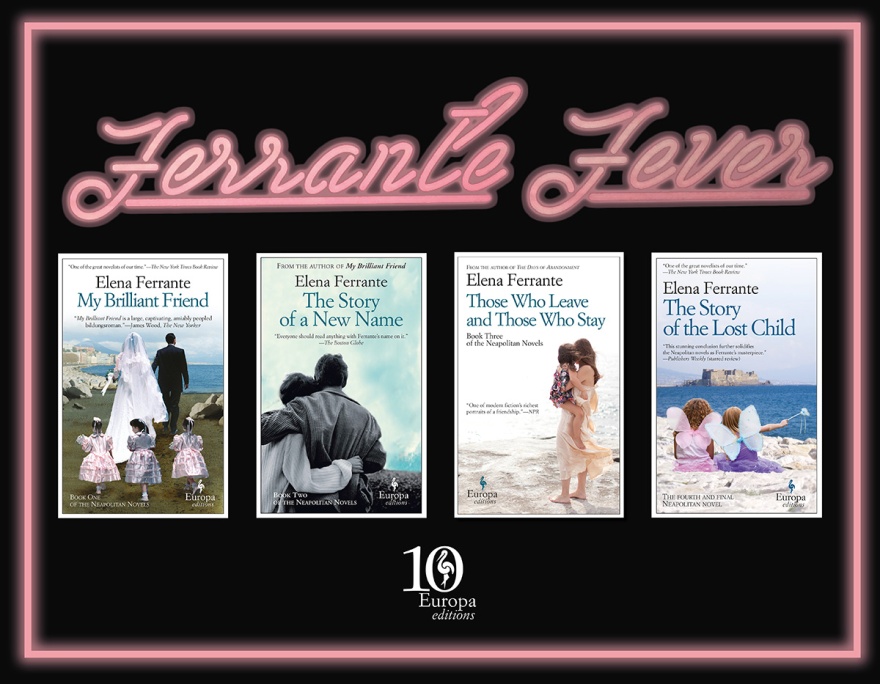
ferrante-fever-eng-low

Elena Ferrante’s Neapolitan Novels

The title Frantamuglia is a made up word that came from Ferrante’s mother. She used the word to describe the contradictory sensations and feelings muddying her brain, or the “jumble of fragments.” The book itself is just this, a jumble of fragments that Ferrante uses to give us glimpses of who she is through the lens of her writing, never giving away too much but still enough to leave readers with a real (fragmented) sense of who she is.

It’s not surprising that Frantumaglia has already been widely reviewed. Thoughtful pieces are appearing across all major media, many dealing with Ferrante’s desire for anonymity. As the New Republic writes:

“In Frantumaglia, Ferrante asserts the most fundamental and important truth of who she is: that she is someone who will do only as she will, and nothing else. That is what is at stake for all women.”

The Guardian ran a lengthy piece last weekend, in which novelist Lisa Appignanesi wrote:

I had no desire at all at the end to know who the real Ferrante is. I feel I already know. Frantumaglia has added to that knowledge and also offered up some unexpected gems… At times, it is as absorbing as Ferrante’s extraordinary fictions and touches on troubling unconscious matter with the same visceral intensity. For those who can’t wait for the next Ferrante fiction to sink into, it provides a stopgap.”

A review in the London Evening Standard states:

The book, exquisitely translated by Ann Goldstein of The New Yorker,opens a window on to the life of one of the most mysterious writers at work in Italy today.”

Interestingly, in a point made by the New York Times, Ferrante’s anonymity has actually made her incredibly public:

As Frantumaglia makes clear, Ferrante really has been a public figure…she [has] given interviews all over the world — to The Paris Review, Vanity Fairand Entertainment Weekly, to newspapers across Europe.”

Despite her mystery, or maybe because of it, she has amassed readers all over the world who remain mesmerised by her work and who will no doubt be delving into Frantumaglia this November.

9781609453701

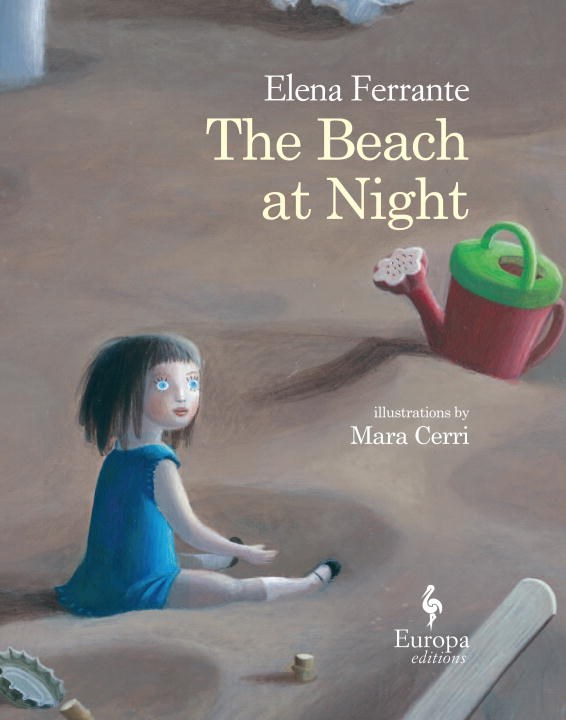
Published in tandem with Frantumaglia is The Beach at Night, an illustrated children’s book that tells the story of a lost doll (a theme readers will recognise from Ferrante’s other works). It was perhaps surprising that Ferrante would chose to produce a children’s book; her worlds are violent, raw and often unforgiving – not what you’d necessarily expect from a children’s author. The Beach at Night focuses on the tale at the center of The Lost Daughter, Ferrante’s 2006 novel that she considers a turning point in her development as a writer. This time, the tale takes the form of a fable, told from the point of view of the doll Celina, who is lost overnight on a beach during a family outing. In typical Ferrante fashion, we see Celina dealing with many of the sensations adult characters do throughout her novels: jealousy, abandonment, sadness and dark dreams. That is, until the sun comes up and Celina is happily found.

beach-at-night-internal-illustration-12

What happens to Celina during that long night on the beach could be described as scary, especially to children aged six to ten, at which the book is aimed. But as Daniela Petracco of Europa Editions said in an interview with The Guardian, it is “a little creepy, but, you know, it’s Ferrante. It was never going to be a sunny story.” In a Times review, the book is “a dark tale with a complex girl-doll heroine and a malevolent male baddie for brave little readers.” In The Washington Post, “Ferrante has started a debate over whether a children’s book she’s about to publish is appropriate for children.” Entertainment Weekly even put together a list of the book’s five scariest lines.

Ultimately though, this is a tale for children, with a happy ending and a strong message. It is also a tale for adults, especially Ferrante fans who will recognise her unique style in its pages. With dream-like illustrations from Mara Cerri, The Beach at Night is a children’s book that only Ferrante could have written, and we can expect it to be a major title in the run up to Christmas.

  • Bill Godber, MD

Flavorwire

Literary Links: Gornick on Ferrante, The Novelistic Election and More

Flavorwire

10 Must-Read Books for November

  Books | By |

Before the publishing calendar settles down for the holidays, November is the month for the heavy hitters: big names like Elena Ferrante, Zadie Smith, Michael Chabon and Jonathan Lethem.

We’ve got them all on our list for the month, but we balanced them out with some lesser-known gems too, from new translations of cult classic texts to illuminating nonfiction about social issues. Read on.


frantumaglia

Frantumaglia; A Writer’s Journey, Elena Ferrante

This collection of interviews and letters from the elusive, but brilliant writer is a gorgeous gift to hardcore Ferrante fever sufferers, full of tidbits about the author’s writing life, her decision to remain anonymous, and the themes in her work, from feminism to family. Although those of us who haven’t read her complete oeuvre would probably do equally as well to pick up one of her novels, Frantumaglia is there for those who need more Ferrante, and need it now.